World News in Brief: More attacks in Ukraine, violence against children in Haiti, refugee IDs in Africa

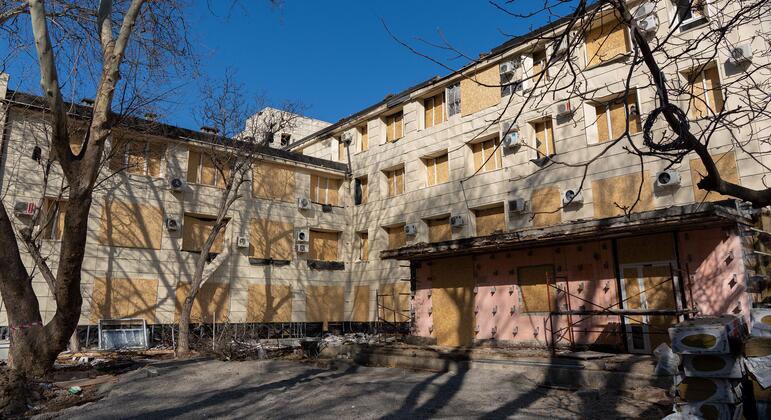
Over the past three days, frontline attacks killed at least 11 civilians and injured nearly 200 others, including five children, as reported by Ukrainian authorities. The cities of Dnipro and Odesa were among the most heavily affected.
At the same time, in the regions of Kherson, Zaporizhzhia and Dnipro, attacks damaged residential buildings, civilian vehicles, health and educational facilities, as well as railway and public transport infrastructure.
Humanitarian response threatened
In response, humanitarian organizations have rapidly mobilized first aid, psychosocial support, hot meals, shelter materials and other emergency relief. However, aid workers themselves are increasingly in the cross hairs.
On May 15, a marked vehicle of a Ukrainian NGO came under direct drone attack while delivering hot meals to a hard-to-reach frontline area in the region of Kherson, severely injuring one aid worker, who remains in critical condition. The driver was also injured in the attack.
In a separate incident on May 14, a drone struck an armoured vehicle operated by a local partner of World Central Kitchen in Kherson, damaging the vehicle but causing no injuries.
According to the UN’s Human Rights Monitoring Mission to Ukraine, in April, Kherson City recorded the highest number of civilian casualties for a single month since July 2025, with 26 people killed and more than 200 injured.
Children face brunt of gang violence in Haiti
Children in Haiti are facing escalating violence as armed gangs increasingly recruit minors, kill and injure children and use sexual violence to terrorize communities.
UN officials warned that the recruitment and use of children by gangs nearly tripled in 2025 compared to the previous year, with children now estimated to make up between 30 and 50 per cent of gang members.
Killings and injuries involving children also nearly doubled over the same period. Sexual violence against children is rampant and being used as a tactic to terrorize communities.
Trapped in fear
During a visit to Haiti, UN Special Representative for Children and Armed Conflict Vanessa Frazier on Monday described children living in “constant fear” amid displacement, intimidation and trauma caused by gang violence.
The UN stressed that children encountered during security operations must be treated primarily as victims and handed over to child protection services.
“Without protecting these children and supporting all children affected by violence, lasting stability in Haiti will not be possible,” Ms. Frazier added.
Officials call for greater investment in reintegration efforts, including education and community support, as many children affected by violence continue to express a desire to return to school and live safely.
UN pushes for digital ID inclusion for refugees and stateless persons
UN representatives met on Monday in Côte d’Ivoire along with government officials, civil society and identity experts to advance the inclusion of refugees and stateless persons in national digital identification systems across Africa.
The annual ID4AFRICA2026 meeting drew on new approaches from Chad, Côte d’Ivoire, Kenya, Mali, Namibia, and Uganda, to make ID systems more inclusive, and was facilitated by the UN refugee agency (UNHCR) and the World Bank.
Inclusion in national digital foundational ID systems is central to UNHCR’s broader agenda of reducing long-term dependence on humanitarian assistance.
“Universality is the defining test of any digital public ecosystem,” said Patrick Eba, Deputy Director of UNHCR’s Division of International Protection and Solutions. “If a system cannot recognise all habitual residents on the territory, it cannot fully serve everyone. And if it cannot serve everyone, it cannot be fully trusted.”
‘Build trust and prevent discrimination’
“We need early inclusion of refugees and people at risk of statelessness in government-led foundational ID systems, alongside strong legal, governance and data-protection safeguards to build trust and prevent discrimination,” said Mr. Eba.
Globally, an estimated 4.4 million people are reported stateless or of undetermined nationality, though the true figure is considered significantly higher.
Millions more refugees lack trusted identity credentials, limiting their access to services and self-reliance.