Since the outbreak was declared on 15 May, considerable progress has been made on testing capacities, Tarik Jašarević, spokesperson for the World Health Organization (WHO) told reporters in Geneva.
Testing for the Bundibugyo virus responsible for the outbreak is available in six locations in the country: in Bunia and Mongbwalu in Ituri Province, Bukavu and Lwiro in South Kivu, Goma in North Kivu, in addition to the capital Kinshasa.
Another four laboratories have been activated in Uganda where cases had been imported from DRC, with 19 confirmed cases and one probable case to date.
However, there is still room for improvement.
Breaking the chain
“We have blind spots where we get a low number of alerts,” Mr. Jašarević said. “There may be transmission chains that are not being detected. There are still people who risk infecting other people, and we need to get them”.
Bruno Michon, Operations Manager for the Ebola outbreak at UN partner the International Federation of the Red Cross and Red Crescent Societies (IFRC), insisted that to stop the spread, investment is needed not only in the medical response, but also in building trust, which is time-consuming and difficult.
“But in this outbreak, it is not optional. It is lifesaving,” he said.
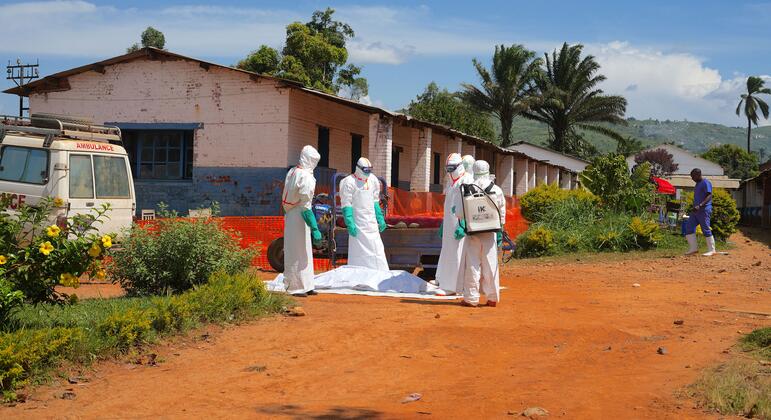
Speaking from Bunia, the epicentre of the crisis, he said that “some people still question whether the disease is real” and believe that the outbreak may have been “invented” to attract foreign aid. Others “see safe and dignified burials as an attack [on] culture and tradition, rather than a measure to protect families and communities”.
Scepticism, doubt and fear have hindered the response in conflict-scarred eastern DRC, by the local community’s distrust of outside authorities, which is significantly increasing the risk of disease transmission.
In the early days of the outbreak, two treatment centres were set on fire in the region, which has been beset by intense fighting, causing the displacement of more than 100,000 people.
At the time, WHO told UN News that the attacks were linked to misinformation campaigns circulating on social media.
“When people are afraid, they may not report symptoms,” explained Mr. Michon. “They may avoid treatment centres” for fear of contamination and prefer to stay at home when they have a fever, “ashamed to tell the family that they are sick”, since significant stigma comes with the disease.
“Families try to bury their loved ones according to traditional practices without knowing the level of risk involved,” he added.
Respectful approach
The IFRC official explained that trust is earned through measures destined to appease the community’s concerns.
“Following community feedback, we started using body bags with a window so that the family can see the face of the deceased” and begin the grieving process, he said.
“When communities told us they feared that chlorine was used to poison them, we did not argue. We demonstrated how disinfectants are prepared.”
“Without trust, we cannot detect cases early,” Mr. Michon continued. “We cannot ensure safe and dignified burials. We cannot even protect families and we cannot stop the transmission.”
“Trust is not a secondary activity in the Ebola response. Trust is central,” he concluded.