RECENT PLAYS ARE approaching the archival density of the Jeffrey Epstein files. Mark Rosenblatt’s “Giant,” about the children’s book author Roald Dahl, arrived on Broadway this season bristling with monstrous excerpts from published accounts of Dahl’s antisemitic screeds. Off Broadway earlier this year, the director Daniel Fish devised “Fauci/Kramer” from the transcript of a brawlsome 1993 C-SPAN debate between the AIDS researcher Anthony Fauci and the AIDS activist Larry Kramer. Last year’s “Liberation,” by Bess Wohl, about the hopes and failures of second-wave feminism, is based partly on interviews with participants in real meetings of a 1970s consciousness-raising group. In 2024, Mario Correa’s “N/A” — the “N” for Nancy Pelosi; the “A” for Alexandria Ocasio-Cortez — offered ferocious, mile-a-minute yet totally imaginary depictions of private conversations between the two congresswomen.
I could go on: The 1933 obscenity case against James Joyce’s 1922 “Ulysses,” the secret back-channel negotiations behind the 1993 Israeli-Palestinian peace accords, a woman’s taped recollections of being held captive for five months and an FBI transcript of another woman’s arrest for leaking classified information have all been remixed for recent drama. And we in the audience have been left like reporters in darkened rooms to judge the resulting dialogue for ourselves. Is it real or does it just sound as if it might be?
This isn’t entirely new. Peter Morgan’s 2006 play, “Frost/Nixon,” borrowed liberally from the British broadcast journalist David Frost’s grilling of Richard M. Nixon in 1977. David Hare’s 2004 play “Stuff Happens” featured another U.S. president, George W. Bush, conferring with members of his administration during the buildup to the 2003 Iraq war. (Some of the dialogue, not to mention the title, was drawn from the public record.) And since 2001, the Civilians, a Brooklyn-based “investigative theater” company, have been creating narratives from interviews conducted with evangelicals, porn workers, prisoners and politicians.
But then the line starts to dwindle. Other than the verbatim collages of Anna Deavere Smith starting in the 1980s and the occasional nostalgia act (like Hal Holbrook’s “Mark Twain Tonight!” from 1954) or courtroom drama (like Jerome Lawrence and Robert E. Lee’s “Inherit the Wind” from 1955), 20th-century plays didn’t generally try to borrow, or simulate, the actual speech of historical figures. No evidence suggests that Shakespeare consulted 11th-century Scottish transcripts to create “Macbeth” some 600 years later. The Greeks kept the muses of theater and history distinct.
So why are playwrights now so eager to eavesdrop on reality, offering audiences facts and quasi facts in the form of dialogue? It’s hardly the purpose, and rarely the case, that theater should profit by telling us what real people said. Drama has historically been considered a form of fiction or poetry. Yet as recent plays approach the feeling of reportage, what’s surprising isn’t that so many fail to convince but that several succeed, in the process inventing a new style befitting our time.
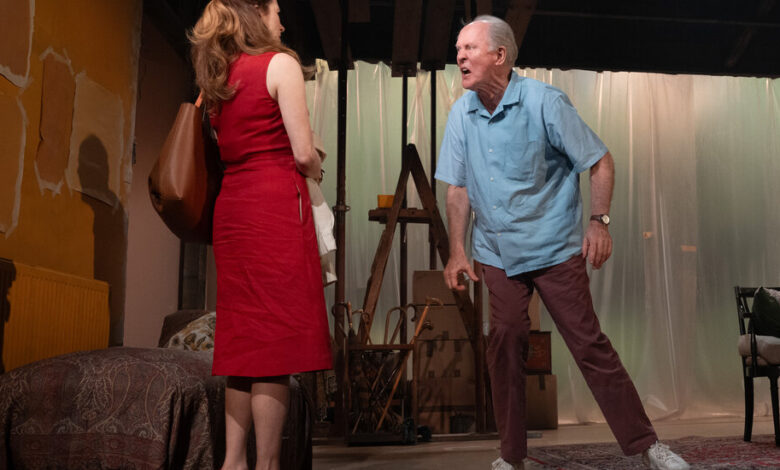
TAKE “GIANT.” SET on a warm afternoon in the summer of 1983, it presents Dahl (John Lithgow) dealing with the repercussions of having made anti-Jewish comments in his review of a book about Israel’s 1982 war in Lebanon. A lunch at his home with representatives of his British and American publishers has been organized to encourage him to walk back the comments before they affect sales of his own book “The Witches,” set to be published later that year. Instead, he doubles down, referring to the media, for example, as “a nasty little cabal of nasty fucking Jews.”
Hearing that line, one would like to take comfort in the idea of dialogue as fiction. But in “Giant,” one cannot. The worst of Dahl’s antisemitic comments are verbatim — and when not verbatim, close enough. “They control the media,” he said of Jews in a 1990 interview eight months before his death. “Jolly clever thing to do.” Yet Rosenblatt writes in a preface to the script that the play is “never striving to be documentary.” The lunch with the publishers’ representatives is plausible but invented, and one character, the American, who’s Jewish, didn’t exist.
That’s why it makes good drama. The combination of direct quotation from published accounts and close approximations in fully imagined scenes creates a compound glue that’s stronger than its components. Having Dahl say awful things at home, in front of his fiancée and within earshot of his housekeeper and handyman, suggests more about his character than similar things he wrote for public consumption. His antisemitism isn’t just a sound bite, it’s embodied — and thus more absolute and complex.
The paradox recalls Marianne Moore’s description of poetry as a form that presents “imaginary gardens with real toads in them.” Regarding “Giant,” the phrase “real toad” is especially apt. But in “Liberation,” it’s the garden that’s real: a feminist group in an Ohio gymnasium 50 years ago. I say “real” because Wohl based most of the play’s characters on women who were part of an actual consciousness-raising group from that era, and drew additional inspiration from her mother’s own circle of friends. What they say sounds real too. In their meetings, the women argue about how to respond to the unenlightened men in their lives (“I think you should kill him”), what the goal of feminism should be (“If we don’t take action, we have no group”) and whether it’s permissible for one character to open the top button of her blouse to get a promotion at work (“She has to get through the day somehow”). Eventually, the narrator figure, a semifictionalized stand-in for Wohl, has a debate with her late mother, who materializes to say the play has “some funny lines” but “you got most of it wrong.” That scene is heartbreaking, even if you know that Wohl’s mother is alive and attended the Broadway production eight times.
The acknowledgment of the blurry space between quotation, paraphrase and guesswork — the subtitle is “A Memory Play About Things I Don’t Remember” — makes “Liberation” feel more accurate. “It has to do with the way theater rewards emotional truth over literal truth,” Wohl told me. “The invented dialogue is all in support of the emotional truths I’m investigating, which spring from tons of research and firsthand conversations.”
Wohl’s method, like Rosenblatt’s, works because, even if the dialogue sounds accurate and is sometimes verbatim, the playwrights take a freer hand with the characters, inventing some and compositing others. Notably less successful are those plays, like Stefano Massini’s “The Lehman Trilogy,” which opened on Broadway in 2021, that work the other way around, putting fake speech into real mouths, in this case those of three generations of the American banking family. Even putting real dialogue in real mouths can be a problem, though: The historic political statements in “Stuff Happens” are never as convincing as what Hare invents because you cannot reach the depths of character with language designed specifically to be shallow.
CURRENT EVENTS HAVE rarely been theater’s forte. Catastrophes that once seemed epochal have over the past two decades merged into one continuous sludge. But it’s not just the pace of the events; it’s how we now encounter them. Social media and A.I. have flooded our field of attention with hot takes and chaotic imagery, leaving us to extract the truth on our own. We learned of the killings of George Floyd, Renee Good and Alex Pretti within hours, with disinformation, false narratives and even, in some cases, deepfake videos soon following.
What the English poet William Wordsworth described as his poetic ideal in 1800 — “emotion recollected in tranquillity” — was for almost 200 years drama’s watch cry as well. But with no tranquillity left in which to recollect emotion, it’s no wonder that playwrights have looked for workarounds. Many have discovered, or rediscovered, the way older crises can serve as analogues for newer ones: AIDS can speak to Covid, Dahl to the antisemitic tropes of today, second-wave feminism to third-wave and beyond. What’s new is that playwrights have begun leaning into the objective techniques of nonfiction to sidestep the noise of fake news.
The best works to emerge from this movement toward facts are those that nevertheless manage to exploit the expressive opportunities of fiction. It may have been Smith, in her verbatim plays, who provided the inspiration, paradoxically achieving the imaginative weight of pure invention while observing strict verbal fidelity. The potency of that approach was established by two of her works from the early 1990s: “Fires in the Mirror: Crown Heights, Brooklyn and Other Identities” (about the riots following the death of a 7-year-old Black boy when a car driven by a Hasidic Jew struck him) and “Twilight: Los Angeles, 1992” (about the violence that ensued after police officers who attacked Rodney King were acquitted in state court). But their power also derived from Smith herself, who was usually the only performer onstage, filtering as many as 40 oppositional voices through her own singular lens. The filtering was itself the drama, making the point that any of us contain the possibility of all of us.
Smith’s achievement has been difficult to replicate in other formats, only partly because of her extraordinary mimetic skills. With a strong enough actor, like Michael Benjamin Washington in the 2019 revival of “Fires,” the play remains overwhelming. But a 2021 Off Broadway revival of “Twilight,” which divided the play’s characters among several actors, dissipated much of its strength. That may be why interview-based dramas in her wake, like those devised by the Civilians and by Tectonic Theater Project (most recently “Here There Are Blueberries,” a 2022 play about the discovery of an album of concentration camp photographs), have inched toward more familiar territory with elaborate settings, projections and song.
Now playwrights are fudging the line between transcription and transformation even further. Often enough, the result, like an A.I. image in which someone has extra fingers, doesn’t pass the most elementary smell test. But handled properly, the combination of “maybe real” and “Could it be?” and “OK, yes, this actually happened” feels strangely right for our time — and serves as good practice for life. When we can no longer trust what real people say, the fictional facts and factual fictions of plays like “Giant” and “Liberation” make for a new kind of realism. Like little else onstage, they feel true.