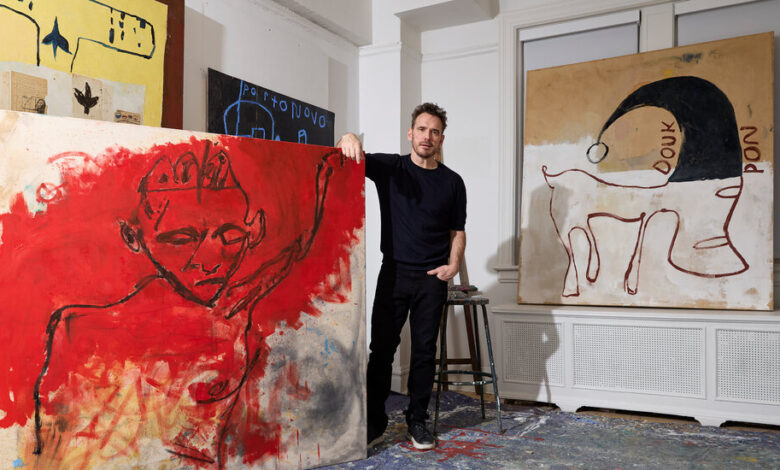
Matt Dillon’s painting studio — in a modest apartment on Manhattan’s Upper West Side — is remarkably neat, the floors freshly papered and his paints and palettes organized in a small closet. This, he says, is only because he’s been in Berlin: “I make a mess. I accept that about myself.” Fixed to a wall is a jagged piece of Masonite slathered in black paint onto which he’s scrawled “Porto Novo” along the top and “Abomey” at the bottom — the names of Benin’s modern capital and the city that was once the capital of the Kingdom of Dahomey, respectively, both of which Dillon visited after filming Claire Denis’s “The Fence” (2025) in West Africa.
Dillon, 62, first became famous playing angsty adolescents in a run of 1980s films — “The Outsiders,” “Rumble Fish” (both 1983) and “Drugstore Cowboy” (1989). His art takes cues from the Neo-Expressionism of that time as well. He paints in a brushy, textural style, nodding to Julian Schnabel’s gnomic marks, Martin Kippenberger’s deadpan distortion and A.R. Penck’s and Jean-Michel Basquiat’s faux-naïf primitivism.
Growing up in Mamaroneck, N.Y., Dillon had no formal art training, but he did have early exposure. His great-uncle created the 1930s-era comic strip Flash Gordon, and his father, a sales manager, moonlighted as a portrait painter. As a young actor, Dillon formed a softball team with Futura and other graffiti artists, with one game memorialized by Andy Warhol in a 1985 diary entry (“Matt Dillon struck out with three people on base, but he was cute”). He learned more about art once he got to the West Coast, where he shared an apartment with the dealer Patrick Painter, becoming familiar with many of the Los Angeles conceptual artists Painter showed, like Mike Kelley and Paul McCarthy. “I loved it,” Dillon says of their work, “but it’s not the way I am.”
For most of his adult life, Dillon painted during the lulls on set, and in hotel rooms. He didn’t make large-scale pieces until a little over a decade ago, when he rented his first studio. Despite, or perhaps because of, the fact that he’s never had gallery representation, his work has earned the admiration of his artist peers. In 2021, the painter John Newsom included his work in a group show at the Brattleboro Museum and Art Center in Vermont alongside that of Donald Baechler and Wendy White; he currently has a painting up at the Watermill Center on Long Island, in an exhibition co-curated by Brian Belott and Noah Khoshbin that also features pieces by Carroll Dunham and Katherine Bernhardt. “He’s an emerging and midcareer artist at the same time, which is an anomaly,” says Michael Nevin, who, along with Julia Dippelhofer, runs the Journal Gallery, where Dillon’s first New York solo exhibition is now on view.
Does he think about being perceived as a celebrity painter? “I like doing different things,” he says. “I guess that can work for you or against you.”
“[Some] people are always going to say, ‘You go over here in this little corner,’” he adds. “The big struggles for me, and probably for a lot of artists, are control and freedom and discipline. The joy is when you accept the thing after you’ve wrestled with it for a long time.”
Photo assistant: Eugene Lee. Rauschenberg artwork: © Robert Rauschenberg Foundation