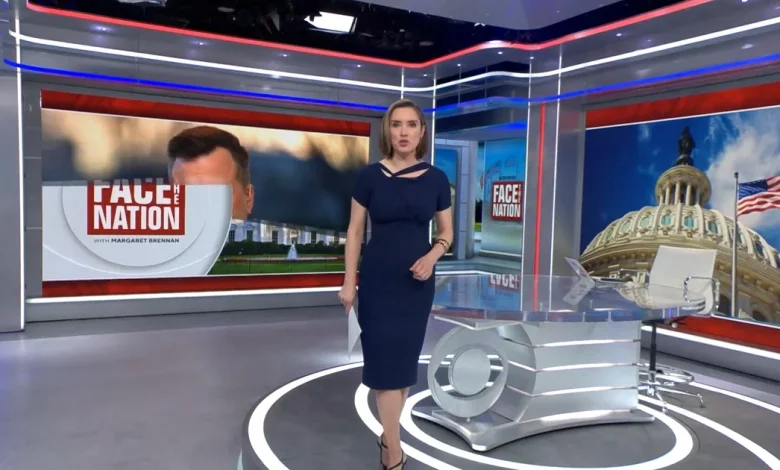
On this “Face the Nation with Margaret Brennan” broadcast, moderated by Margaret Brennan:
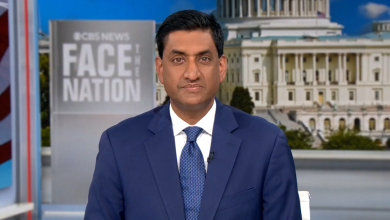
- Rep. Ro Khanna, Democrat of California
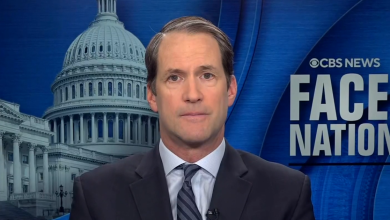
- Rep. Jim Himes, Democrat of Connecticut
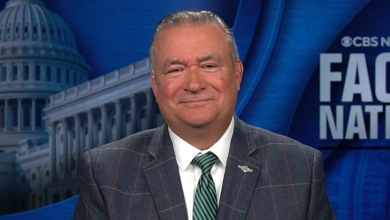
- Rep. Don Bacon, Republican of Nebraska
- Chris Krebs, CBS News cybersecurity contributor, and Ben Buchanan, Biden adviser and now a professor at Johns Hopkins and an adviser to Anthropic
- Rye Barcott, Marine veteran and With Honor founder
Click here to browse full transcripts from 2026 of “Face the Nation with Margaret Brennan.”
MARGARET BRENNAN: I’m Margaret Brennan in Washington.
And this week on Face the Nation: President Trump’s choice of national intelligence director has a chilling effect on the intel community and Capitol Hill.
Plus, Democrats reckon with a Senate candidate who’s drawing national attention for the wrong reasons.
President Trump’s grand plan for the Washington, D.C., skyline isn’t the only thing shaking up the city this summer. Last week, he appointed a man with no intelligence experience to head up the top agency in the intelligence community.
Bill Pulte, who serves as the director of the Federal Housing Finance Agency, is the heir to a building fortune and close to the president. He’s rubbed some Cabinet members the wrong way.
(Begin VT)
SENATOR THOM TILLIS (R-North Carolina): Did you actually tell Pulte you were going to punch him in the face?
SCOTT BESSENT (U.S. Treasury Secretary): No, sir. I actually said I was going to kick his ass.
(End VT)
MARGARET BRENNAN: And his appointment has sparked concern among even Republicans trying to reauthorize a surveillance program that’s due to expire this week.
The top Democrat on the House Intelligence Committee, Jim Himes, and Nebraska Republican Congressman Don Bacon will also join us.
Meanwhile, Democrats are keeping close watch on Tuesday’s main Senate primary, as their candidate faces some alarming allegations of past aggressive behavior. We will talk with a top Graham Platner supporter, California Democrat Ro Khanna.
Finally, should the government have more control over the exploding field of artificial intelligence?
It’s all just ahead on Face the Nation.
Good morning, and welcome to Face the Nation.
We have a lot to get to today, but we begin this morning with Democratic Congressman Ro Khanna of California.
Good to have you here in person.
REPRESENTATIVE RO KHANNA (D-California): Good to be back.
MARGARET BRENNAN: You’re just back from Maine.
And, on Tuesday, there’s a primary there for Democrats. It will help to determine who is going to challenge Susan Collins for her seat. She is the longtime Republican senator who has held onto it. This is all ultimately about who is going to control Congress, control the Senate.
There’s been a lot of excitement around Graham Platner, who we mentioned there right at the top. He’s a veteran, an oysterman with this anti- establishment progressive message. Why are you still campaigning for him after all of these questions about action, comments, activity in his personal life?
REPRESENTATIVE RO KHANNA: Well, we had a rally planned.
And I want to be clear. His actions were misogynistic, they were shameful, they were wrong. But they didn’t come as a surprise to a lot of the folks in Maine. People in Maine knew that he had had two tours of duty in Iraq. He came back broken, in a dark place. That doesn’t excuse his behavior, but they knew this. He was in Washington.
And then he went back to Maine, and he started an oyster farm. He took accountability. He himself has said it was shameful, and he had redemption. And now he’s running on a platform of national health insurance, when Susan Collins is voting to cut it.
He’s talking about taxing billionaires. Susan Collins is for tax breaks to billionaires. And he’s opposed to this foreign war, where Susan Collins supported the war in Iran, and that’s why I’m still supporting him.
MARGARET BRENNAN: But I want to go through some of what we’re referring to here in specifics.
REPRESENTATIVE RO KHANNA: Of course.
MARGARET BRENNAN: The campaign acknowledged the candidate sent sexually explicit texts to multiple women while he was married, quite recently. He’s acknowledged he had a tattoo with Nazi symbols that he’s since covered up, but he claimed he didn’t know the linkage and the symbolism.
And he’s had social media posts insulting rural people, downplaying sexual assault. He has apologized or said he regrets some of that behavior. As you just alluded to, he has also referred to the fact he has dealt with PTSD and some alcohol issues. Are you confident all the damaging info is out?
REPRESENTATIVE RO KHANNA: That’s what he says.
My sense is, before the primary, a lot of this has come out. Obviously, look, if there was evidence of violence. I would not support him. If there was evidence of sexual assault, I would have zero support for him. He acknowledges that he was misogynistic, it was shameful.
One thing I want to make very clear, we should not be attacking the women who came forward. We should not be attacking the journalists. Some people have been attacking the “New York Times” journalists. They’re – they did their job.
We should focus on acknowledging it was misogynistic, acknowledging it was wrong, moving on with redemption, and then focusing on his issues, which are stopping the war, taking on the billionaire class.
MARGARET BRENNAN: You said there was no evidence of violence. You – in your view, there’s nothing credible at this point?
REPRESENTATIVE RO KHANNA: My view is that, even according to the “New York Times” piece, they said there was no harm, no injury.
There was toxicity, and there was verbal intimidation, which I condemn. But Graham has made it clear that there was no evidence of violence. That, to me, is a red line.
MARGARET BRENNAN: OK.
Well, because there’s this woman, Lyndsey Fifield, who dated him for about two years’ time, and she’s been posting on social media, speaking on the record about their relationship. She said he left an AR-15 lying around his Capitol Hill apartment when he lived here, told her if anyone broke in he’d rape them to show he’s dominant.
She did say he never hit her or punched her, but said he could be rough, and she described being grabbed by her shoulder. She described him pulling her arm as she was refusing to get out of a car. Years ago, the mantra was, believe all women. Do you believe her?
REPRESENTATIVE RO KHANNA: Yes. And I don’t think our side should be attacking her. And I appreciate her courage from coming forward.
I know some people are saying, oh, she’s a Republican. I think that is irrelevant.
MARGARET BRENNAN: OK.
REPRESENTATIVE RO KHANNA: I believe her. I think Graham acted shamefully, and he acted, as “The New York Times” characterized it, as a toxic relationship. It is shameful. It is ugly. It happened in a dark period of his life.
And the Maine voters that I met said they don’t like it. They knew that he had these chapters. They are willing to extend him grace and redemption, and they’re focused now on what he’s running for. But I do not think we should be attacking her.
MARGARET BRENNAN: So it is his campaign, the Platner campaign, that described the accuser as a GOP operative that – who has dedicated her career to electing Republicans. She is a conservative.
Would you advise the campaign to stop attacking her?
REPRESENTATIVE RO KHANNA: Absolutely. They should not attack her. They should not attack the “New York Times” reporters who wrote the story. I know those reporters. They have written things critical of me. That’s what journalists do. Donald Trump is the one who attacks the press. Our party doesn’t attack the press.
Our party believes that you treat women with equality and respect in all aspects of their lives. Graham Platner did not do that in the early 2000s.
MARGARET BRENNAN: Yes.
REPRESENTATIVE RO KHANNA: He should just say what he has said to Maine voters. That was a shameful period in his life. He’s ashamed of that conduct.
And that’s what makes him different, is that he’s taken accountability for that period of his life. Others, like Trump, have never taken accountability.
MARGARET BRENNAN: So you mentioned the PTSD, and he has been very open about that, what he went through, coming back from, I believe, three tours in Iraq, and then he worked in a private capacity in Afghanistan.
But some veterans groups have said that, you know, he’s basically using it as an excuse for bad behavior…
REPRESENTATIVE RO KHANNA: I don’t think…
MARGARET BRENNAN: … and maligning them in that way.
REPRESENTATIVE RO KHANNA: It’s not an excuse. It doesn’t justify him being in toxic relationships or saying misogynistic things.
MARGARET BRENNAN: Because it sounds like it’s being used as an excuse.
REPRESENTATIVE RO KHANNA: Well, I don’t view – in fact, in my remarks, I said it’s not an excuse. It’s – but it’s the truth. It’s his truth of who he was.
But what it should tell us is, we broke a lot of people in this country by sending people to Iraq. Susan Collins sent people to Iraq. And now, on the 100th day of a war in Iran, we’re breaking more people. Gas is through the roof.
MARGARET BRENNAN: Yes.
REPRESENTATIVE RO KHANNA: Food is through the roof. And this Iran war is an illegal war, immoral war, an unstrategic war. And Graham Platner is running to stop it.
That is the big issue that Maine voters were talking about…
MARGARET BRENNAN: Yes.
REPRESENTATIVE RO KHANNA: … the war that’s increasing gas prices, the lack of health care.
But I don’t believe PTSD should be an excuse for bad behavior. But we do need to recognize the toll these wars are taking on people.
MARGARET BRENNAN: Yes.
And Platner did protest against the war, but that was before he enlisted in the Marines…
REPRESENTATIVE RO KHANNA: Yes.
MARGARET BRENNAN: … and then subsequently worked in a private capacity in Afghanistan, another war zone.
REPRESENTATIVE RO KHANNA: Well, he was patriotic.
MARGARET BRENNAN: OK.
REPRESENTATIVE RO KHANNA: Look, I ran against the war in Iraq in 2003. That was how I started. He was opposed to the war.
We made a mistake by getting into the war in Iraq.
MARGARET BRENNAN: Yes.
REPRESENTATIVE RO KHANNA: Now, he served the country, but one of the reasons he went into PTSD, if you talk to him, is, he said, I realized that my service did not have a purpose for doing good.
And now you’ve got Susan Collins, who has been an apologist for the war in Iran on this 100-day – what have we achieved? You still have an Iranian regime there.
MARGARET BRENNAN: Yes.
REPRESENTATIVE RO KHANNA: They still have the nuclear fuel there. The gas prices are through the roof. And why is Platner in the race? Because he’s saying, stop these foreign wars.
MARGARET BRENNAN: Yes.
So, it just – I raise this because I have heard Democrats argue over this issue, and the worry that they are ceding the moral high ground that they want to hold in order to stand on it and criticize Republicans, right?
CBS News has spoken to a former campaign official who expressed concern about the lack of vetting of Platner.
REPRESENTATIVE RO KHANNA: Well, look…
MARGARET BRENNAN: This sounds like it’s just – you know, this is just politics.
REPRESENTATIVE RO KHANNA: Like I said, the people in Maine were not surprised. I mean, it was a surprise to the national story.
They knew that, when he was in D.C., he had shameful parts of his life. Then he came back. He started an oyster farm. He was on the ocean for years. He found himself. But the big issue for voters, in my view, is, are you for these wars? Are you for taxing billionaires? Are you for national health insurance?
And that’s the contrast. And the campaign is a vetting process, and the voters of Maine are asking these tough questions.
MARGARET BRENNAN: The campaign is the vetting process?
REPRESENTATIVE RO KHANNA: Well, the primary campaign. I mean, it’s been a year of campaigning that he has – that he has had.
MARGARET BRENNAN: Can he survive another scandal? You have five months here.
REPRESENTATIVE RO KHANNA: Well, it depends.
What, I’m not – you know, I mean, obviously, if there was any evidence that comes out that there is actual domestic violence or assault, I have zero tolerance for that. I led the fight against the Epstein class, which has been a cover-up for sexual abuse, with Thomas Massie.
MARGARET BRENNAN: Yes.
REPRESENTATIVE RO KHANNA: I have been at the forefront of championing women’s rights and rights of survivors. But here you have a case of someone who had a dark chapter in his life, was in toxic relationships, was ashamed about it, who served this country.
And the Maine voters are saying, look, let’s give him some grace, and his focus is stopping these wars.
MARGARET BRENNAN: Yes.
REPRESENTATIVE RO KHANNA: And it’s getting national health insurance, and it’s taking on economic inequality.
MARGARET BRENNAN: OK. And that is the progressive message that you are supporting.
Ro Khanna, thank you for your time.
REPRESENTATIVE RO KHANNA: Thank you.
MARGARET BRENNAN: We will be right back.
We turn now to the top Democrat on the Intelligence Committee, Representative Jim Himes, who joins us this morning from Greenwich, Connecticut.
Welcome back to Face the Nation.
REPRESENTATIVE JIM HIMES (D-Connecticut): Good to be with you, Margaret.
MARGARET BRENNAN: Congressman, President Trump appointed the Federal Housing Finance Agency head, Bill Pulte, to be the next director of national intelligence.
The president said it is temporary, but, even in that acting role, he could stay in it for over 200 days, and it would bypass congressional approval. Pulte himself was Senate-confirmed for the housing job. Three Democrats voted for him. Do you know if he has a security clearance to do the intelligence work?
REPRESENTATIVE JIM HIMES: Well, that’s a very narrow question, Margaret.
I have heard a senator said that he did not have a security clearance, but that’s almost beside the point, right? He doesn’t have an iota of national security experience. And the president is putting him in this most sensitive of roles.
And, you know, you pointed out that he was confirmed for the sort of obscure Federal Housing Finance Agency job. This was before he used that job to try to go after the president’s political enemies, Adam Schiff and Letitia James.
And so now we’ve got a little bit more data on Bill – Bill Pulte. And the reason this is so controversial is that we know that’s his distinguishing feature. He’s going to do whatever it is that he believes is in the president’s political interests.
And there is no way that the authorities and assets of the intelligence community can be in the hands of an individual who has showed that his sole reason for being in Washington is to do the president’s political laundry.
MARGARET BRENNAN: Well, the president did say he wants Pulte to find out more about the 2020 election. At this point, is there anything Congress can do to stop him from taking on this role?
REPRESENTATIVE JIM HIMES: Well, you know, you haven’t asked about it, but, you know, this Pulte nomination, which, by the way, created bipartisan outrage – you saw the public commentary from my Republican colleagues.
The president did this 10 days before the expiration of our most important and also very controversial collection authority. That’s FISA 702, right? I mean, I just heard Senator Warner describe it as throwing a grenade into a very, very delicate situation.
And so, no, can – I mean, can Congress do anything to stop this? Not really. But the president has now assured through this appointment that the single most important intelligence collection tool, at a time when the Iranians are, you know, thinking about conducting operations abroad, maybe in the United States – I mean, you just could not have come up with worse timing for what is probably the worst appointment into the intelligence community I have ever seen.
MARGARET BRENNAN: Well, this was a controversial authorization. You’ve been working really hard on trying to convince both Democrats and Republicans to extend it even before Bill Pulte was chosen.
We know, yesterday, the Republican chairs of Senate Intel and Judiciary sent a letter to the White House saying expect a lapse in the collection of foreign intelligence later this week. So, how do you get around this? Because it sounds like there is planning for this key surveillance tool you say is so important to just not be in place.
REPRESENTATIVE JIM HIMES: Yes.
No, I saw the letter from Tom Cotton and Chuck Grassley. And, look, I think, at one level, they’re acknowledging reality, which is that the Pulte appointment has taken 702 reauthorization off the table. You know, we voted in the House and passed a bill with 42 Democrats.
I will tell you that at least half of those Democrats are gone, because they will say, look, I – I wasn’t very comfortable with this authority to begin with. And we don’t need to get into why it’s controversial, but it is controversial.
But, with Bill Pulte, who is, you know, absolutely dedicated to abusing authorities, no, I’m not there. And so you saw in the Senate yesterday a failure to proceed on a reauthorization.
So the only right answer here, Margaret, the only right answer – and I don’t have a lot of confidence that it’s going to happen – is that the president says, you know, oops, that was a mistake, and pulls the Bill Pulte appointment in favor of somebody who will give not just Democrats, but everybody, more confidence that this is somebody with some experience who won’t abuse intelligence authorities.
That’s the only way out of this mess. And, you know, President Trump could do that right now.
MARGARET BRENNAN: Well, it sounds like you’re saying Democrats are going to withhold their votes until Pulte’s selection is pulled.
The president often doesn’t back down, as you know. Is – is the White House, is Marco Rubio, who was up on Capitol Hill just a few days ago, working in any way with Democrats to find an acceptable alternative here to Bill Pulte?
REPRESENTATIVE JIM HIMES: Well, remember two things.
Number one, where I work, in the House of Representatives, we already passed the FISA reauthorization bill. So the question you ask is really a question for the Senate. I guess the Senate could just vote…
MARGARET BRENNAN: Right, but this is the thing standing in the way, you’re saying, right?
REPRESENTATIVE JIM HIMES: It’s – well, the Senate needs to pass a bill or pass the House bill, right.
So, my point is that the House already passed a bill. Now, by the way, if we had to pass another bill in the context of Bill Pulte, I don’t think we could, but, you know, it’s not Marco Rubio. You said, is Marco Rubio working with Democrats to find an alternative to Bill Pulte?
MARGARET BRENNAN: I know.
REPRESENTATIVE JIM HIMES: That’s – that’s not the way this works, right? The president needs to sober up and realize that this appointment is arguably, in the – in the – you know, you know, basket of awful appointments he has made, this is probably the worst and most dangerous.
So, I mean, I hope he can find a way out, because you’re right, he doesn’t like to back down, but he’s also not going to like the terrorist attacks that might happen if there is no 702 collection authority, because, look, you know, Tom Cotton can try to say that this is a Democratic issue all he wants, but the Bill Pulte appointment was, you know, panned in a – in a strong bipartisan way.
MARGARET BRENNAN: Yes.
But, just to be clear, you’re saying that the Senate has to vote on the bill that the House sent up. If they make any changes, would you still vote for FISA reauthorization if Pulte is in the spot?
REPRESENTATIVE JIM HIMES: So, the only way – so the House passed a bill; 42 Democrats supported it. That would not be true today. So, you know, I suppose…
MARGARET BRENNAN: You would withhold your vote this time around?
REPRESENTATIVE JIM HIMES: And I don’t think it can happen. I have – well – well, again, it’s – this – it’s – the ball is in the Senate’s court.
MARGARET BRENNAN: Right.
REPRESENTATIVE JIM HIMES: The House passed it.
I don’t think – look, if I had to vote again on this thing, knowing Bill Pulte’s background, experience and what he’s done in this obscure federal agency, I don’t think I could look myself in the mirror in the morning and say, yeah, this is a guy…
MARGARET BRENNAN: Yes.
REPRESENTATIVE JIM HIMES: … who should, you know, have control and access to this authority.
And, look, I think – I think there’s lots of Democrats and Republicans who feel that way.
MARGARET BRENNAN: I reached out to you, wanting to also speak to you about Ukraine before this controversy erupted here with Bill Pulte.
You were just there. You were meeting with President Zelenskyy. Just in the past few days, Ukraine has carried out some very deep strikes, St. Petersburg, some, what 600 miles into Russian territory. How do you judge where the war is at this moment in time? Is Russia still winning?
REPRESENTATIVE JIM HIMES: No, Russia is not winning. And, I mean, that’s the headline, right? Ukraine is now winning, by any standard, right?
On a – on a net basis – you know, the front lines are moving a couple of square miles here or there, but, on a net basis, the Ukrainians are now retaking territory. The Ukrainians are inflicting a mind-boggling number of deaths on the Russians.
You know, for every square mile that the Russians move, they’re giving 250, 300 Russian men in fatalities. You know, the Russian casualties are like 30,000 a month. It’s just staggering. I mean, it’s like a – it’s like a Vietnam every two months for the Russians there.
And, as you pointed out, the Ukrainians are now striking deep into Russian territory in a way that has compromised, you know, 30 percent or so of their – of the Russian refining capacity. So, make no mistake. The Ukrainians are winning this war.
MARGARET BRENNAN: On Israel and Iran, there is some reporting, both in “The New York Times” and another television network, that the U.S. has increased its counterintelligence threat against Israel, some specifics there about them spying on American officials.
Is that accurate? Has the U.S. raised its counterintelligence threat level against Israel?
REPRESENTATIVE JIM HIMES: Yes, I – I’m – I can’t really comment on what we’re doing with respect to counterintelligence.
But it is worth reflecting on the fact that you see a divergence now between U.S. policy and Israeli policy. I wasn’t on the phone call, so I can’t validate that it happened the way it was reported in the press.
But, of course, the press reported that President Trump was screaming obscenities into the phone at the – at Prime Minister Netanyahu, because the president, of course, is very motivated to get this conflict over. He knows the effect of $1.50 increase in gas prices on his political fortunes and his party’s political fortunes.
So, you know, we – Israel is not, though they are an ally, they are not a member of the Five Eyes agreement, in which we agree not to spy on each other, and that sort of thing. So, again, without answering your question, which I cannot do…
MARGARET BRENNAN: Yes.
REPRESENTATIVE JIM HIMES: … you know, this is a moment in time where the president is at odds with the Israeli leader.
MARGARET BRENNAN: Well, we will continue to track that story.
Jim Himes, thank you for your time this morning.
Face the Nation will be back in a minute. Stay with us.
(ANNOUNCEMENTS)
MARGARET BRENNAN: We go now to Republican Congressman Don Bacon, who joins us from Omaha, Nebraska.
Welcome back to Face the Nation.
REPRESENTATIVE DON BACON (R-Nebraska): Thank you, Margaret.
MARGARET BRENNAN: Before we get to national security, I want to ask you about politics and candidate quality.
Last month, Texas Republicans chose to make Ken Paxton their Senate nominee, despite the fact, as Texas A.G., he was impeached by the Republican-controlled House on multiple charges of abuse of office, including bribery.
His wife is divorcing him on what she called biblical grounds because of adultery, and he was indicted in 2015 on securities fraud charges that were later dropped. Despite all this, the president backed him over sitting Senator John Cornyn, and so did Texas Republicans.
For your party, does Trump’s favor carry more weight than character?
REPRESENTATIVE DON BACON: I think, in many cases, it does.
His endorsement in a primary is often – carries – carries the most weight. I think it was a mistake. I think this has hurt the president. A lot of senators feel very close to Senator Cornyn. He was a big fund raiser. He helped a lot of these Republicans get elected all over the country, so there’s a lot of loyalty to John Cornyn.
In fact, I know him too, and I admire the guy. And now they’ve – we’ve nominated a guy in Texas that is probably the most vulnerable in a general election, and it puts that seat up for grabs. So, it was – I don’t think it was a wise decision.
And I would say one other factor here is, the Democrat nominee. I think he’s also pretty weak, though, in Texas. So, I think they both – both sides have nominated people that are vulnerable in a general.
But John Cornyn could have won the seat easily, and now the Republicans will be spending a lot of money to hold it.
MARGARET BRENNAN: Yes.
REPRESENTATIVE DON BACON: And I think it was a mistake.
MARGARET BRENNAN: I know you have chosen to retire, but if you were having to campaign and explain all this, including the higher gas prices, how would you persuade voters?
REPRESENTATIVE DON BACON: Well, I try to – in my case, I try to show – I try to do what’s right, whether it’s President Trump’s position or not his position.
And I just try to look voters in the eye that say, hey, I support Ukraine. I think tariffs are a mistake. I have votes to back it up.
MARGARET BRENNAN: Yes.
REPRESENTATIVE DON BACON: I also support the fact that we secured the border.
I support generally what we’re doing in Iran, because Iran has been…
MARGARET BRENNAN: Yes.
REPRESENTATIVE DON BACON: … waging war against us for 47 years.
So, I just try to call balls and strikes, and I try to be honest, and I try to do, once I’m elected, what I campaign on.
MARGARET BRENNAN: All right, well, we’ll let you call some of those balls and strikes on the other side of this commercial break that I have to take. So, please stay with us.
We have more questions for Congressman Bacon and a lot more Face the Nation. Stay with us.
(ANNOUNCEMENTS)
MARGARET BRENNAN: We will be right back with a lot more Face the Nation with Congressmen Bacon and more questions. Should the government regulate artificial intelligence?
(ANNOUNCEMENTS)
MARGARET BRENNAN: Welcome back to “FACE THE NATION.”
We return now to our conversation with Nebraska Republican Congressman Don Bacon.
Congressman, I want to go to Europe and talk about Ukraine but let me first ask you about what was said at Normandy on Saturday.
Secretary Hegseth seemed, in his remarks, to link immigration to the legacy of the D-Day landings by allied forces who were liberating Europe from the Nazis.
Take a listen.
(BEGIN VC)
PETE HEGSETH, DEFENSE SECRETARY: Sadly, today, different European beaches are stormed by different, dangerous ideologies. Beaches in Spain and Italy and Greece and Bulgaria, boats and men arrive. When will European capitals do something about that invasion?
(END VC)
MARGARET BRENNAN: I’m not sure who the allies were in that analogy, but I wonder what you make of Hegseth’s remarks?
REPRESENTATIVE DON BACON (R-NE): You know, Normandy’s a time to celebrate a great day. You know, it was – I’ve been on the beaches of Omaha. And, you know, we lost about 3,000 troops on that beach on one day. That’s where the focus should have been. It’s a chance to celebrate with our allies. We worked together to defeat Nazi Germany.
And one of the concerns that many of us have when it comes to this administration and particularly the Pentagon right now, they’re very critical of Europe. They’re critical of the E.U. They’re critical of NATO. They’re critical of a lot of the countries that make up NATO. And you never hear them criticize Russia. And that bothers us. Why are they so weak on the Russia, which affects Ukraine foreign policy, their policy toward the Baltics.
What they are quick to always want to criticize Europe. It reminds me of the message that Secretary Hegseth sent to the vice president on Signal when he said how much he loathed Europe. Well, I think that’s not good for America. It’s not good for our national security. And we – our allies, we have to work together to counter Russia, to counter China, to help us in the Middle East. And it’s constant criticism, along with the president’s threats towards Greenland, as well as Canada, it’s hurt us. Our allies have lost a lot of trust.
So, I don’t think these comments by the secretary were helpful.
MARGARET BRENNAN: Yes. Well, I know you have been taking a stand against Russia and for Ukraine. You did that this past week, along with some of your colleagues, as you put it in remarks on the House floor, “this is our Churchill moment or our Chamberlain moment and, by God I’m going choose Churchill.” Seventeen Republicans joined you. The last time we saw a vote on Ukraine aid, there were 100 Republicans supporting it. What was going on here and how do you get the Senate to take up what you did get over the line?
REPRESENTATIVE DON BACON: Well, a couple things here.
First of all, the president has had a policy of wanting to negotiate a settlement. I don’t think it’s working. He has – too much has tried to act like an umpire, trying to work with two different people in a boxing match. But that’s not the case. You have a country that’s invading Ukraine. They’re bombing cities every night. There’s a good versus evil here and America should be, you know, unabashedly for the right side here. The democracy, the country that wants free markets, the country that wasn’t to align with us.
Russia hates us. I don’t know why the president can’t see that. Putin hates the United States. He hates what we stands for. So, that’s a problem there.
MARGARET BRENNAN: Yes.
REPRESENTATIVE DON BACON: When it comes to the House, the speaker has not wanted his – not wanted to get in front of the president on this. And so he lobbied pretty hard, and we call whipping, against this vote. And I think he was wrong.
I waited for a year and a half in this Congress to get something done on Ukraine and we’ve done nothing. There’s been no votes, no policies from the leadership here or the president to support a country that’s fighting for its life. I agree with the – your previous interview that Ukraine has the upper hand right now, but Russia is bombing those cities every night, and we should be there to help them to defend against these ballistic missile attacks.
The speaker whipped against us, and that’s why it drove that number down. I think he was wrong. He says he’s pro-Ukraine, but the actions speak louder than words.
MARGARET BRENNAN: President Zelenskyy was on this program last Sunday asking for more interceptors, but also he made clear that he wants friendly countries in Europe who have a good relationship with the U.S. To be able to produce the Patriots, as well. I know your colleague, Mike Turner, wrote to the president last week asking for that part to be delivered on.
Do you support it? I mean, what’s the holdup?
REPRESENTATIVE DON BACON: I do support it. We cannot produce enough Patriots right now to handle what we’re doing in Iran to provide Ukraine, but also we need to have these same missile defenses in Asia for whether it’s North Korea or China, and we’re not producing enough. So, we should look for our allies to help create additional production lines. I know Ukraine would love to help do that, and they need these missiles very badly.
What I would do in this case, and we have a low stockpile because of Iran, I would sit down with our allies and just look at what assets we have and come up with a plan to give anti-ballistic missile technology and capabilities to Ukraine. And we can’t do it all, but we should sit down with the allies and build a plan to get it done.
MARGARET BRENNAN: Don Bacon, Republican from Nebraska, thank you so much, sir.
We’ll be right back.
(ANNOUNCEMENTS)
MARGARET BRENNAN: Should the government regulate A.I. And if so, how?
We’re joined by CBS News cyber contributor Chris Krebs, who ran CISA in the first Trump administration, and Ben Buchanan, who advised President Biden and is now a professor at Johns Hopkins and an adviser to Anthropic.
Good to have you both here.
CHRIS KREBS: Good to be here. Thanks for having us.
MARGARET BRENNAN: So, this was a big change because President Trump and his advisers clearly saw something that led to a shift in their policy. They were very light touch. Literally don’t do anything. And now there was this executive order, just a few days ago, to have some step towards, I don’t know if we can call it regulating it because it’s voluntary, but that the companies have to voluntarily provide their very sensitive technology 30 days before releasing it to let the government have the first look. What does this accomplish, Chris?
CHRIS KREBS: Well, I think the biggest concern was, while there had been a sense that generative A.I. and some of the more advanced tools were giving cyber attackers and defenders better capabilities, it wasn’t until about two months ago where Anthropic released their Mythos – or at least announced their Mythos preview that really brought it, I think, to the forefront with cabinet secretaries like Scott Bessent in Treasury and some other folks. They became more concerned. They go to the White House, say, hey, we need to take a bit more of a proactive approach. And so –
MARGARET BRENNAN: They got concerned because business entities –
CHRIS KREBS: Yes, I mean in part the Treasury – the finance sector banks, Jamie Dimon at J.P. Morgan and a number of others were like, whoa, whoa, whoa, we need to pause, we need to think about what we’re doing here, and we need to take a bit more robust security-focused approach on how we – as this avalanche of vulnerabilities that will be discovered by A.I., how we prepare and ensure that we’re not going to be overwhelmed.
MARGARET BRENNAN: Ben, 30 days for the government to conduct a full security vetting. Is that possible or is this just sort of window dressing to say the government’s doing something?
BEN BUCHANAN (Former White House Special Adviser for Artificial Intelligence): In the Biden administration we built a capability at the A.I. Safety Institute to do quick, voluntary testing for A.I. systems, including for cyber risks and for bio risks. So, I think the tests themselves can go quickly. But that doesn’t mean the government is going to do that in a fulsome way. So, the jury, I think, is still out on how the president chooses to implement this.
MARGARET BRENNAN: Right.
BEN BUCHANAN: But the timing here I think is not one of the pieces that worries me. It’s more getting the details of what does this testing look for?
MARGARET BRENNAN: Right. And what’s the consequence?
BEN BUCHANAN: Exactly. Yes.
MARGARET BRENNAN: So, like, can the government stop it? The whole risk and worry had been this would get in the way of America’s arms race with China. Does this get in the way of America’s arms race with China?
BEN BUCHANAN: Not as – not as it’s currently written. No, I don’t think so. And I don’t even think even more stringent versions would.
MARGARET BRENNAN: OK.
BEN BUCHANAN: I do think what’s happening here is you see the government wrestling with something that we wrestled with in the Biden administration. This technology is coming from the private sector. And in many respects it’s the first revolutionary technology that is primarily in its current form from the private sector.
MARGARET BRENNAN: Meaning?
BEN BUCHANAN: Think (ph) about nukes or space or so much more.
MARGARET BRENNAN: OK.
BEN BUCHANAN: The government has and has had a role in all of those technologies, inventing them, shaping them. It doesn’t really have that in A.I. So, the Trump administration is now trying to figure out, how does it want to assert itself in this new domain that actually is quite different conceptually than many of the ones that came before it.
MARGARET BRENNAN: And, in Congress, they haven’t regulated really.
CHRIS KREBS: Yes. In fact, the executive order is very clear when it says, this is not a licensing regime. There is not a pre-clearance mechanism. But it does set up a structure where the NSA, the National Security Agency, can define what a covered model is, and then bring those models into a – the 30-day peer (ph) review. And then you can look at maybe what some of the vulnerabilities that could be discovered and then you can share those out with defenders, with industry, so that they are prepared.
But separately this week you had Congressman Obernolte introduce draft legislation that may give a requirement for submitting some of these subsequently covered models for peer (ph) review and auditing by independent bodies on a twice a year basis.
MARGARET BRENNAN: Unclear if that’s got a future, though, that legislation.
CHRIS KREBS: But it – but it’s starting the conversation, which I think is critical.
MARGARET BRENNAN: OK.
So, the president did say to reporters that all the big A.I. leaders are coming to the White House quite soon. He has said he’s looking into the U.S. government, taking an ownership stake in some A.I. companies. Meaning, us U.S. taxpayers would own stakes. And it’s been reported that OpenAI’s Sam Altman also pitched an idea to Senator Bernie Sanders about transferring 50 percent of the equity of the top A.I. companies to a public fund.
To both of you, would that work? What does that do? Is that just retrofitting what you said, which is the government needs to have some kind of hand in here?
BEN BUCHANAN: It’s certainly conceptually trying to adjust – address that question of what’s the relationship between the public and private sector. I think something that is that drastic, the devil is really in the details and we don’t have any details of this meeting or even of Senator Sanders’ proposal. So, I think we’ve got a long way to go in making that real, and it feels, in Congress, with me of, what does it mean to let the private sector run here. So, I think there’s a lot of complexity that’s yet to be worked out on that proposal.
CHRIS KREBS: And on that note, it also creates a significant governance challenge, you know, when you control, when you own part of – whatever the tool is, it creates a conflict of interest and some self-dealing, perhaps, if you’re also trying to regulate it.
So, again, the details here are what’s going to matter. It is interesting that it’s almost a horseshoe effect where you have both Republicans and Democrats that are talking about, you know, perhaps we need to take an ownership stake in these models.
MARGARET BRENNAN: They seem scared. I mean that seems to be the takeaway that’s forcing a change in position. And, I mean, Anthropic, the company you advise, called for an international pause in A.I. development because of how fast the systems are improving. As I understand it, the concerns the models are becoming so advanced they can fix themselves without humans being involved.
BEN BUCHANAN: Well, the dynamic here that’s very interesting is what we call recursive self-improvement. So, the A.I. systems help the A.I. companies generate the next version of the system. And that can show up in a number of ways. One of the ways it can show up is the A.I. systems write the computer code for the next version. Another one is the A.I. systems do the research and some of the math and underlying conceptual work that leads to efficiencies in the next system. And now we increasingly see A.I. systems helping design the chips that are the lifeblood of this.
So, I think it is the case for a variety of reasons, recursive self- improvement, massive infrastructure investments. We should expect these systems to get – continue to get very good, very quickly. And that does raise real national security questions no matter who is president.
MARGARET BRENNAN: Do you expect that most companies are going to comply with this voluntary 30-day review, Chris?
CHRIS KREBS: Well, I think there’s a separate mechanism that probably has more teeth. And that’s what was issued on Friday, a national security presidential memorandum on the national security enterprise in the use of A.I., which allows the Department of Defense to use the power of the purse. The procurement mechanisms to dictate what the policies are and who needs to submit to reviews and who will, you know, follow certain presidential – or, rather, department-level direction. So, I think the executive order is an interesting framing for a government-wide approach, but the real movement, I think the real teeth is what’s happening at the Department of Defense in dictating what the policies are for how vendors can dictate to the government on how models can be used.
BEN BUCHANAN: In the Biden administration in 2023, we brought the companies to the White House to meet with the president and they all made voluntary commitments, which they then followed through on, to do independent red team testing for risks like cyber, for bio, to publish their testing results to the public. And they followed through on that. So, I do think there’s a history here of companies working with government, but I suspect both sides are going to have to do a lot more as this technology gets better.
MARGARET BRENNAN: I recall during the Biden administration there was this agreement between the U.S. and China not to let A.I. touch nukes.
BEN BUCHANAN: That’s right.
MARGARET BRENNAN: As I understand it –
BEN BUCHANAN: That’s right.
MARGARET BRENNAN: There’s discussion about the risk towards biological weapons. OpenAI, Anthropic and Google’s A.I. initiative signed a letter saying there should be a law to keep A.I. out of bio, biological weapons.
BEN BUCHANAN: Chris spoke very well, and he spoke very well about the cyber dimensions of the current set of models. I would look at these current models not as cyber models but as generally capable models. And the bio frontier is –
MARGARET BRENNAN: What does that mean? Sorry.
BEN BUCHANAN: They can do expert tasks in a wide variety of areas, not just in cyber. Also in bio and the like. This was something that we were very alert to in the Biden administration. There’s a long section on bio in the president’s executive order in 2023. There’s upside. You know, A.I. can do a lot for medical discovery, but there also is legitimate concern that A.I. is outperforming Ph.D. level virologists on virology questions, and that could abet a bio weapon risk. That is not hypothetical.
MARGARET BRENNAN: OK, well now you’re scaring me.
I mean do they need to be bilateral agreements between countries or this is because we have the edge at this moment. America needs to set the rules of the world for everyone. I mean essentially they did for nuclear weapons, right? We had – we had them first. But it was out of fear.
CHRIS KREBS: Look, A.I., emerging technologies, quantum is going to present, I think, the same problem. But we’re now entering this governance space where technology development is moving faster than democratic oversight and control can allow, or provide.
MARGARET BRENNAN: Yes. They’re (INAUDIBLE).
CHRIS KREBS: And I think your earlier question about they’re scared, there’s fear, it’s – it’s they’re overwhelmed. They don’t really understand the technology. It’s very complex. Understanding how to meaningfully intervene that’s consistent with the American regulatory tradition, that’s light touch, free markets, capital markets, we are seeing a bit of a – I think a divide here on how to interact. But again, you are seeing some interesting parallels in direction of travel that’s consistent between the administration, the Congress and Democrats and Republicans that understand something needs to be done. We’re just not quite sure what the mechanisms are just yet.
MARGARET BRENNAN: Yes. And the technology is moving really quickly while that’s being debated.
Gentlemen, thank you for bottom lining this for us.
We’ll be right back in a moment.
(ANNOUNCEMENTS)
MARGARET BRENNAN: On Friday we spoke with Rye Barcott, a Marine veteran who was the founder of With Honor, an organization that supports military and public service veterans for higher office. His new book is “Courage Can Save Us: Ten Extraordinary Americans and the Fight for our Future.”
We began by asking about the group’s mission and why it’s so important now.
(BEGIN VT)
RYE BARCOTT, AUTHOR, “COURAGE CAN SAVE US”: We helped recruit and train and help elect veterans to take our pledge to serve with integrity, civility and courage, including the courage to work across party lines at a difficult time to do so.
Through that process, I’ve gotten to know many of them quite well. And so, what I decided to do was select 10, an even balance of five and five, all of whom were in office at a very difficult, challenging time for the country and really unpack where their courage came from and then look at moments of courage, both in military service, as well as in politics and elected office. Sometimes that courage is quieter, it’s more of a moral courage versus a physical courage, which they may have encountered in the military. But that was the – that was my approach to this book, which I’ve written principally for students. I’d like to see more students being able to study courage. I define courage as a form of service. That is taking risk in the service of something larger than yourself. It’s not self- interested. It’s serving what’s referred to oftentimes as the common good.
MARGARET BRENNAN: Well, you do need to inspire younger people, it sounds like, because when we look at the polling, overall 17 percent of Americans, according to Pew, trust the government in Washington to do what’s right all or most of the time. Our own CBS polling has showed the younger generation’s dispirited.
BARCOTT: Yes.
MARGARET BRENNAN: They’re anxious about their futures. So, how do you inspire them to join a system that they believe is broken?
BARCOTT: Yes. I mean I think a lot of young people are – they’re feeling lonely. There’s a lack of a sense of purpose. One of the great things that I found through military service was that it gives you a – it gives you some – a sense of something larger than yourself and a common mission with Americans from all different walks of life.
So, one of the key takeaways for the book is to find a – to find a route into public service. And that’s one of the goals with this.
MARGARET BRENNAN: Do you worry we are at a point where the kind of moral courage you’re describing is nearly impossible to fill? Because when we look at the kind of partisanship out there, and then you look at, for example, the redistricting that may lock in that partisanship and disincentivize the thing you say you want to encourage, bipartisanship, the forces are kind of against you.
BARCOTT: The forces are really going against us. And most Americans want courage but feel like they see very little of it or none of it. And what I wanted to shine a light on is to say that this still exists. It still exists. Here are ten examples of it. It’s hard. We need to celebrate it when it – when it arises.
MARGARET BRENNAN: You know, past military service doesn’t guarantee a flawless life. I mean you’ve gestured to that.
BARCOTT: Yes.
MARGARET BRENNAN: But we’ve been talking about this with candidates – the Democratic Senate candidate of Maine, for example, other lawmakers. Do you ever look at candidates and say, despite your service, I can’t support you? How do you make that call?
BARCOTT: We do. We only – we usually only do about 10 percent of the overall vets that run. This year there is more vets running than any year before. It’s an increase of over 30 percent across party lines. Quite encouraging. Many of those vets are not running in races that are winnable. So, that’s one criteria. But really, fundamentally, we look at character. And you have to commit to this pledge to serve with integrity, civility and courage. We watch how people conduct themselves on the campaign trail. We interview individuals that served with them in the military under duress. And it’s only about 10 percent of the veterans that make the cut.
Once they serve in office, they really need to be committed to it. They have to – they have to maintain that trust across party lines. That doesn’t mean that they’ll agree on every issue. Most issues they don’t. But they’ll maintain trust and relationships. It doesn’t always work.
MARGARET BRENNAN: You talk about the pledge. When we looked it up, the pledge is to bring civility to office, participate in a cross-partisan veterans caucus. You asked members also to pledge just to meet with a member of the opposing party once a month and then join them in significant bipartisan legislation.
BARCOTT: That’s right. And importantly –
MARGARET BRENNAN: Can we watch (INAUDIBLE) on that?
BARCOTT: I mean it seems to have –
MARGARET BRENNAN: Congress isn’t legislating these days.
BARCOTT: Yes. Yes, yes, yes, yes, can we amp it up and expand it more?
MARGARET BRENNAN: Right.
BARCOTT: I hope so. We have continued to grow and maintain that cohesion, but it has been difficult. I mean there have been many moments over the last eight years where we’ve – where, you know, relationships get frayed. I mean January 6th was one example.
MARGARET BRENNAN: Yes.
BARCOTT: You know, many others. And this matters for the country, but it is not easy. And, you know, meeting alone is one thing, but then actually being willing to have the courage to put your name with another and say, we’re going to do this and we’re going to stand for this, even though I might get attacked for working with the enemy. I mean it’s a crazy thing.
There’s a – there’s a survey out that 80 percent of Republicans and Democrats, registered Republicans and Democrats, of course about 40 percent of the country are non-affiliated. But among those that are a affiliated, over 80 percent refer to the other side as the enemy. I mean that’s what we’re – and that’s why with this book I think courage can save us as a country. The us is the flag. It has a crack in it. It’s not broken, but it has a crack in it. We’re in a serious place as a nation. We’re turning 250 years old. But at the end of the day, I believe this is a – this is an optimistic outlook. There are a lot of people that are still, you know, serving for the good of service. Something that’s larger than themselves.
(END VT)
MARGARET BRENNAN: Our full conversation is on our website, YouTube page and podcast platform.
We’ll be right back.
(ANNOUNCEMENTS)
MARGARET BRENNAN: That’s it for us today. Thank you all for watching. Until next week. For “FACE THE NATION,” I’m Margaret Brennan.