Early Cancer Detection: A Guide to New Technologies and Their Risks, ETHealthworld



Approaches for early cancer detection are evolving rapidly. Whole-body MRI, blood-based genomic tests, and breath analysis—the options available to a curious, health-conscious individual are growing. How should a layperson make sense of these choices?
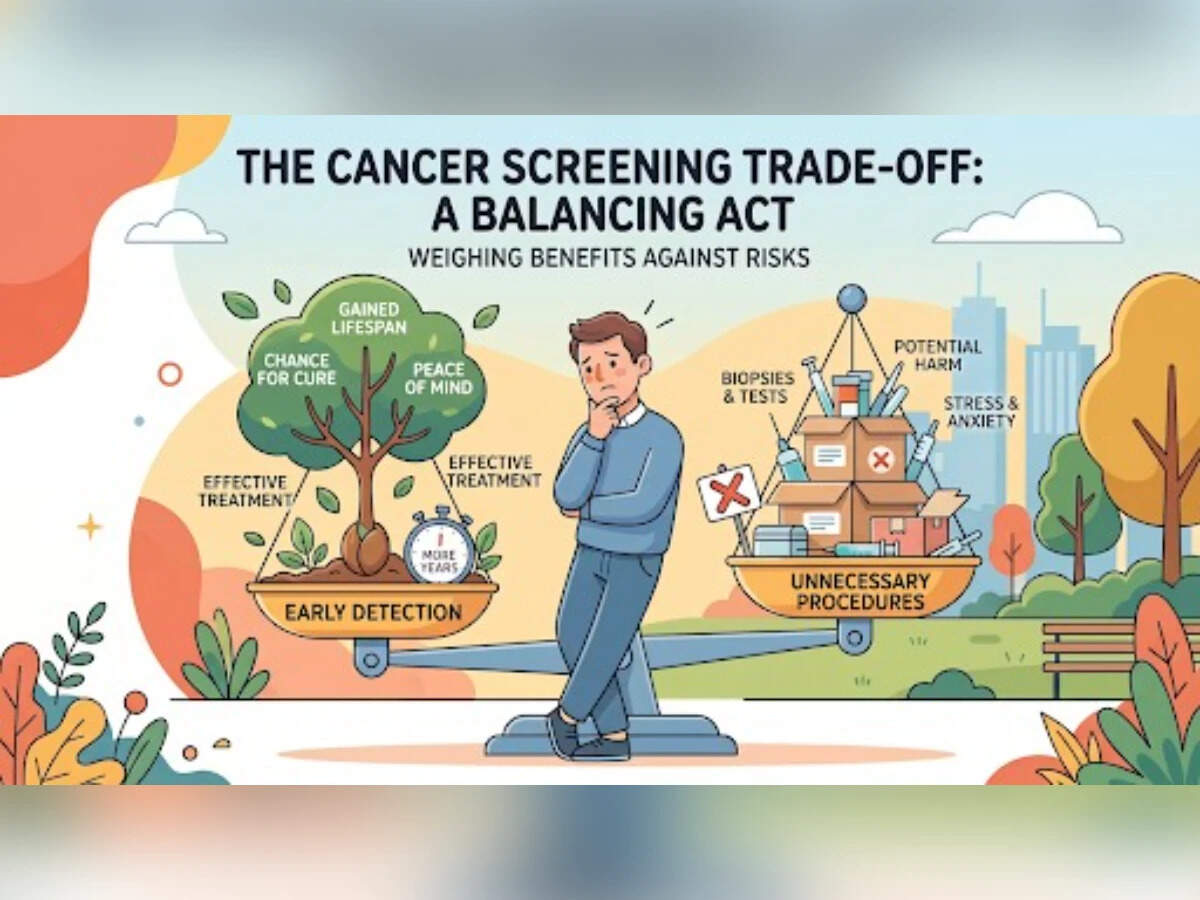
The key is understanding one central principle: every early cancer detection test involves a trade-off between benefit and harm.
The Benefit
Early detection, followed by surgical removal, remains the closest thing medicine has to a cure for cancer. Often, by the time symptoms appear, a tumour has already spread—first to nearby tissue, then to distant organs. At that stage, surgical cure becomes harder to achieve, treatment becomes more aggressive and less likely to succeed, and survival timelines shrink.Lung cancer makes this case starkly. It is among the faster-progressing cancers—within a few months to a few years, it can advance from an early stage to a late one. Cure rates fall from 74% at stage I, to 47% at stage II, to 21% at stage III, to just 5% at stage IV1. More broadly, across cancer types, stage I-III diagnoses carry better cure rates than stage IV. Which raises an obvious question: if finding cancer early can change outcomes substantially, why isn’t everyone getting tested?
The Challenge
Because detecting cancer early is one of medicine’s hardest technical problems.
Small tumours can remain silent for years before causing symptoms. Since there is often no clear trigger to investigate, testing must happen proactively. Cancer is also relatively uncommon at any given moment. Hundreds of people may need to be tested to identify a single case. And no test is perfect; each misses some cancers on the one hand, and flags harmless lumps or technical artefacts as suspicious findings on the other. Together, these pose a challenging problem.
Test enough people and you may detect more cancers. But you may also create more false alarms. Different methods—including mammography, colonoscopy, low-dose CT, MRI, clinical examination, and newer blood-based approaches—each involve trade-offs between detecting cancer early (benefit), missing some cancers (false negatives) and flagging abnormalities that are not cancer (false positives). Understanding this trade-off is essential to navigating the early detection landscape.
What a Negative Test Actually Means
A negative result does not mean you are cancer-free.
Different tests detect different cancers. Mammograms detect breast cancer. Colonoscopy detects colorectal cancer. Low-dose CT detects lung cancer. Whole-body MRI and blood-based genomic tests cast a wider net. None of these tests is perfectly sensitive. All miss some cancers. Therefore, a negative result does not offer a full guarantee. It does offer meaningful reassurance, which will become increasingly comprehensive as technology advances.
Why a Positive Test Needs Confirmation
This is where it starts getting even more complex. A positive result does not mean you have cancer. Early detection tests are designed to identify signals that deserve further evaluation rather than establish a conclusive diagnosis. Confirmation happens in stages, usually starting with additional imaging scans and progressing to a biopsy if the findings remain suspicious. Only a positive biopsy confirms the diagnosis. And most positive findings are flagged as harmless either in subsequent imaging or by the biopsy. This is where there is potential for harm.
The Harm
To detect one case of cancer, many individuals without cancer may be subjected to imaging and biopsy. These “unnecessary” imaging scans involve radiation exposure that induces cancer risk, the very thing one is trying to protect from. The entire process also leads to additional psychological burden. Overall, these harms must be carefully weighed against the benefits.
Balancing Benefit & Harm
This is the central tension in detecting cancer early. Often, the more sensitive a test is at catching cancer, the more false positives it will generate. The benefit of catching more cancers must be weighed against the harm done to the more people who are investigated unnecessarily. Push for maximum sensitivity and you maximise cancer detection—but you also maximise unnecessary procedures. Do nothing and you avoid all that, but if cancer is there, you may not find it until it is too late.
The right answer lies somewhere in between. Medical guidelines distill the most mature evidence and provide recommendations. Meanwhile technology continues to evolve, providing new choices. It is then left to each individual to evaluate the latest evidence and weigh the benefits and the harms for themselves. Here is an example.
An Example: Lung Cancer
The standard-of-care test for lung cancer detection is a low-dose CT scan (LDCT). It is quick and easy. It can detect very small tumors that are just a few mm in size. It involves modest radiation exposure, ~1 millisievert (mSv)2. For context, a year of ordinary life exposes you to about 3 mSv. If positive, the LDCT test is followed by a full CT scan (7 mSv), and only if that too is positive is a biopsy done. A cancer diagnosis is confirmed only when the biopsy comes back positive.
Now for the numbers that give pause. If 2,000 people in the general population above age 50 undergo annual LDCT scans for ten years, ~6 cancer cases will be detected—but 1 additional radiation-induced cancer may occur over their lifetimes as a result of the cumulative radiation exposure. This trade-off is not favourable.
Early Lung Cancer Detection in Heavy Smokers
For heavy smokers above 50—those who have smoked the equivalent of a pack a day for 20 years—the picture shifts decisively. Because cancer is far more common in this group, the same annual LDCT programme detects ~100 cancer cases for every 1 additional radiation-induced cancer2. Long-term studies have confirmed a 20% or larger reduction in lung cancer mortality3. Annual LDCT is now a firm recommendation in medical guidelines across the US and Europe for this segment of the population.
If you are a heavy smoker: do the annual low-dose CT. Period.
But What About Non-Smokers?
Here is something important to hold onto: several reports suggest that 40% of lung cancer cases in India occur in non-smokers4,5, and likely several more occur in smokers below the heavy-smoking threshold. So if you do not fit the heavy-smoker profile, you are not off the hook. What are your options?
Emerging Early Detection Options for Lung Cancer in Non-Heavy Smokers
For those who are not heavy smokers—which is most people—blood-based genomic tests offer a promising alternative. These tests sequence DNA circulating in the bloodstream (called cell-free DNA, or cfDNA) and look for patterns in this DNA characteristic of cancer. Multiple published studies report specificities above 98%, meaning fewer than 2 false positives per 100 people tested. And crucially: no radiation.
What about sensitivity—the proportion of early-stage lung cancers these tests actually catch? Published figures vary widely, from around 22% to above 90%6,7. Sensitivity is likely toward the higher end for larger tumors and even for small tumors that are biologically very active, and toward the lower end for small, more quiescent tumors. The field is evolving rapidly and further studies will pin down exact numbers. For the purposes of the calculation below, let us assume 50%.
Here is what the trade-off looks like in practice. If 2,000 people above age 50 undergo an annual genomic blood test for ten years, then less than 400 will test positive and progress to LDCT, reducing the number of LDCTs and the consequent radiation-induced cancer risk substantially. As a result, ~50-100 cancer cases will be detected for every 1 additional radiation-induced cancer, a trade-off similar to that for heavy smokers, in whom mortality gains are proven.
This genomic blood test does not replace the LDCT for heavy smokers. But for the majority who fall outside the high-risk threshold, it offers a low-harm, radiation-free entry point into a rational screening pathway—catch the signal in the blood first, then investigate with imaging only when warranted.
Early Detection Guidelines Across Cancer Types
The balance of benefit vs harm needs careful consideration. Decades of evidence weighing the two have shaped today’s guidelines for early detection, which include:
- Annual mammograms for women above 45 for breast cancer
- Annual LDCT for heavy smokers above 50 for lung cancer
- Colonoscopy every 3–10 years above age 45 for colorectal cancer
- Pap tests every 3 years (ages 21–29)
- HPV testing every 3–5 years (ages 30–65) for cervical cancer
- Oral visual screening for tobacco users in India for oral cancer
These interventions save lives but a large fraction of cancers still fall outside these pathways. This is where newer technologies may expand the frontier.
Emerging Multi-Cancer Early Detection Technologies
Blood-based genomic tests offer broad cancer coverage with intermediate sensitivity but very low false positive rates, deliberately designed to minimize downstream harm from unnecessary imaging and biopsies as illustrated in the example above. These tests are not yet standard-of-care because evidence is still evolving. However, large studies suggest they may reduce stage IV diagnoses by an additional ~14% when layered on top of guideline-recommended testing8.
Whole-body MRI represents another emerging option. Unlike CT-based approaches, it avoids radiation and can survey multiple organs in a single scan albeit at slightly lower sensitivity. However, it detects false positive findings in most subjects, which are largely benign.9 These can trigger additional testing, cost, and anxiety. For these reasons, its precise role in routine early detection remains uncertain and is still being defined.
What Should Individuals Do Today?
In summary, the future of early cancer detection will likely not depend on a single perfect test, but on intelligently combining technologies to find cancer before it has the chance to spread while minimizing harm. Individuals should of course follow guideline recommendations after due consultation with their physicians. In addition, individuals should carefully assess the benefit to harm equation from emerging technology options and include them in the regimen after due review of the literature or consultation with expert clinicians.
References
Hubbell, Earl, Christina A. Clarke, Karin E. Smedby, Hans-Olov Adami, and Ellen T. Chang. 2024. “Potential for Cure by Stage across the Cancer Spectrum in the United States.” Cancer Epidemiology, Biomarkers & Prevention : A Publication of the American Association for Cancer Research, Cosponsored by the American Society of Preventive Oncology 33 (2): 206–214.
Johnson, Peter, Thomas Round, Jane Warwick, et al. 2026. “NHS-Galleri: Primary Results from a Randomised Controlled Trial to Assess the Clinical Utility of a Multi-Cancer Early Detection (MCED) Test in Population Screening.” Journal of Clinical Oncology, ahead of print, June 10. https://doi.org/10.1200/JCO.2026.44.17_suppl.LBA100.
Klein, E. A., D. Richards, A. Cohn, et al. 2021. “Clinical Validation of a Targeted Methylation-Based Multi-Cancer Early Detection Test Using an Independent Validation Set.” Annals of Oncology : Official Journal of the European Society for Medical Oncology 32 (9): 1167–1177.
Krishnamurthy, A., R. Vijayalakshmi, V. Gadigi, R. Ranganathan, and T. G. Sagar. 2012. “The Relevance of ‘Nonsmoking-Associated Lung Cancer’ in India: A Single-Centre Experience.” Indian Journal of Cancer 49 (1): 82–88.
National Lung Screening Trial Research Team, Denise R. Aberle, Amanda M. Adams, et al. 2011. “Reduced Lung-Cancer Mortality with Low-Dose Computed Tomographic Screening.” The New England Journal of Medicine 365 (5): 395–409.
Rampinelli, Cristiano, Paolo De Marco, Daniela Origgi, et al. 2017. “Exposure to Low Dose Computed Tomography for Lung Cancer Screening and Risk of Cancer: Secondary Analysis of Trial Data and Risk-Benefit Analysis.” BMJ (Clinical Research Ed.) 356 (February): j347.
Vasudevan, Smreti, Vidya Krishna, and Anurag Mehta. 2022. “Lung Cancer in Non-Smokers: Clinicopathological and Survival Differences from Smokers.” Cureus 14 (12): e32417.
Bahadur U, Vishwanath D, Hiremath P, Rathod N, et al “CancerSpot: a multi-cancer early detection test using targeted methylation sequencing” n.d. https://aacrjournals.org/cancerres/article/85/8_Supplement_1/2343/758441/Abstract-2343-CancerSpot-a-multi-cancer-early?__cf_chl_f_tk=D5r.8m9A5hdJ17ewcfyLP6O2EoUoEIGrUDe0X6bQjZo-1782933745-1.0.1.1-ASvVCZsObQtNJ.cGfK6.AMXPp57jt4cf0dB8nnqcORA.
Zugni, Fabio, Anwar Roshanali Padhani, Dow-Mu Koh, Paul Eugene Summers, Massimo Bellomi, and Giuseppe Petralia. 2020. “Whole-Body Magnetic Resonance Imaging (WB-MRI) for Cancer Screening in Asymptomatic Subjects of the General Population: Review and Recommendations.” Cancer Imaging : The Official Publication of the International Cancer Imaging Society 20 (1): 34.
The article is written by Dr Ramesh Hariharan, CEO and Co-founder, Strand Life Sciences.
Disclaimer: The above content is non-editorial, and TIL hereby disclaims any and all warranties, expressed or implied, relating to it, and does not guarantee, vouch for or necessarily endorse any of the content.