
WHO’s representative in DRC, Dr Anne Ancia, told reporters in Geneva that there are more than 500 suspected cases including 130 suspected deaths, but that only 30 cases have been confirmed in the country so far.
The agency is working closely with the authorities and rushing more testing kits to eastern DRC to identify cases of infection of Bundibugyo virus, a species of Ebola virus for which there are no vaccines or therapeutics.
“We have significant uncertainty about the number of infections and how far the virus has spread,” Dr Ancia said.
Early cases
Speaking from Bunia in Ituri province, where cases were initially detected, Dr Ancia said that the outbreak has also reached North Kivu, with confirmed cases in Butembo and Goma. Uganda has also confirmed two imported cases.
WHO chief Tedros Adhanom Ghebreyesus declared the outbreak a public health emergency of international concern on Sunday morning. He has expressed concern about the “scale and speed of the epidemic”.
Uncertainty still surrounds how and where outbreak started.
“I don’t think that we have the ‘patient zero’ for now,” said Dr Ancia. “What we know for now is that on 5 May, there was…a person who died in Bunia. The body was brought back [to] Mongbwalu…and put in a coffin. And then the family decided that the coffin was not worth the person. And therefore…they changed the coffin. And then there was the funeral, and it’s from where it started.”
Detection of the initial cases was slowed down by the fact that local tests in Bunia showed negative results for the Zaire strain of Ebola. The wide range of symptoms – fever, fatigue, diarrhoea and vomiting – also complicated the task of making a swift diagnosis, with the additional difficulty that the nosebleeds that are also associated with the disease did not begin until day five of infection, the WHO official explained.
Kinshasa breakthrough
In the end, it was only through tests in Kinshasa that the presence of Bundibugyo virus was finally revealed.
Dr Ancia said that there is a focus on the international level on potential candidate vaccines or treatments which could help fight the outbreak. A WHO technical advisory group was scheduled to meet on Tuesday afternoon “to provide further recommendation to the WHO and its Member States on which potential vaccine should be prioritized”, she explained.
Ervebo, a vaccine against the Zaire Ebola virus, is under consideration, the WHO representative said, but “it would take two months for it to be available”.
While a vaccine could bring additional prevention and protection to the affected populations, the key to containing transmission lies in grassroots work within the communities to raise awareness, fight misinformation and ensure adherence to sanitary measures, especially around funerals.
“If we use coercive measures and the population does not agree, we will see bodies disappear. We will see suspected cases refusing to come to the hospitals and health facilities,” Dr Ancia warned, underscoring health workers’ continuing engagement with schools, churches and community leaders.
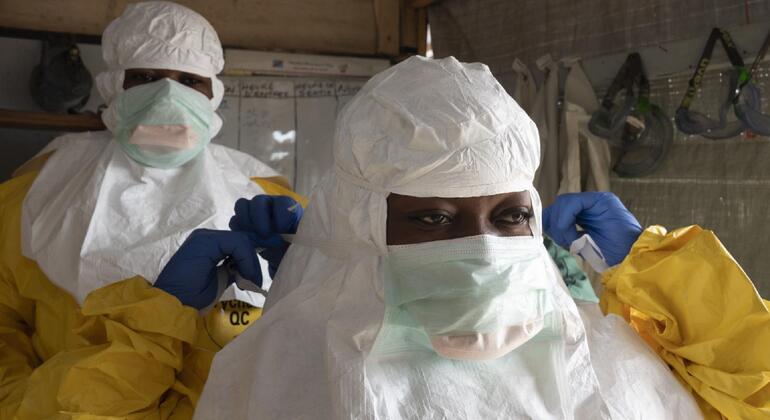
WHO is supporting the Government-led response with more than 40 health professionals on the ground and through the deployment of supplies and extra diagnostic capacity, in what remains a “highly complex epidemiological, operational and humanitarian context”, characterized by insecurity and displacement, the WHO representative said.
IDP vulnerability
The UN Refugee Agency (UNHCR) said on Tuesday that the affected provinces of Ituri and North Kivu are home to more than two million internally displaced people and returnees, while healthcare capacity remains weakened by conflict.
There is also concern for refugees living in the affected areas. In Ituri some 11,000 South Sudanese refugees require preventive assistance while in North Kivu’s capital, the rebel-held city of Goma, more than 2,000 Rwandan and Burundian refugees need sanitary supplies.
The most recent outbreak of the Ebola Zaire virus in DRC ended in December 2025, and the trauma of a major epidemic in North Kivu and Ituri in 2018-19 persists among the population.
Dr Ancia stressed that while it may be two months until a vaccine is available, “it is not two months before the outbreak will be done”.
“Remember the previous one, it took two years,” she warned.