
A decades-long decline in the U.S. fertility rate has confounded policymakers and economists alike, with experts pointing to possible causes ranging from the economic fallout of the Great Recession to changing public attitudes about parenthood. Now, one economist is pointing to another factor: the iPhone.
A new research paper by Middlebury College economist Caitlin Myers found that Apple’s 2007 introduction of the iPhone accounted for 33% to 52% of the decline in the fertility rate. The reasons are rooted in the enormous social impact of putting a powerful new device in people’s pockets that not only tethered them to the internet but also rewired how we relate to each other — or whether we choose to relate at all.
Specifically, Myers posits that many people have turned to their phones as a substitute for in-person interactions. The technology also makes it easier to view pornography and find information on contraception, factors that have weighed on birth rates, according to the paper.
“What we are seeing is that the places that have the iPhone have big fertility changes relative to the other places,” Myers told CBS News.
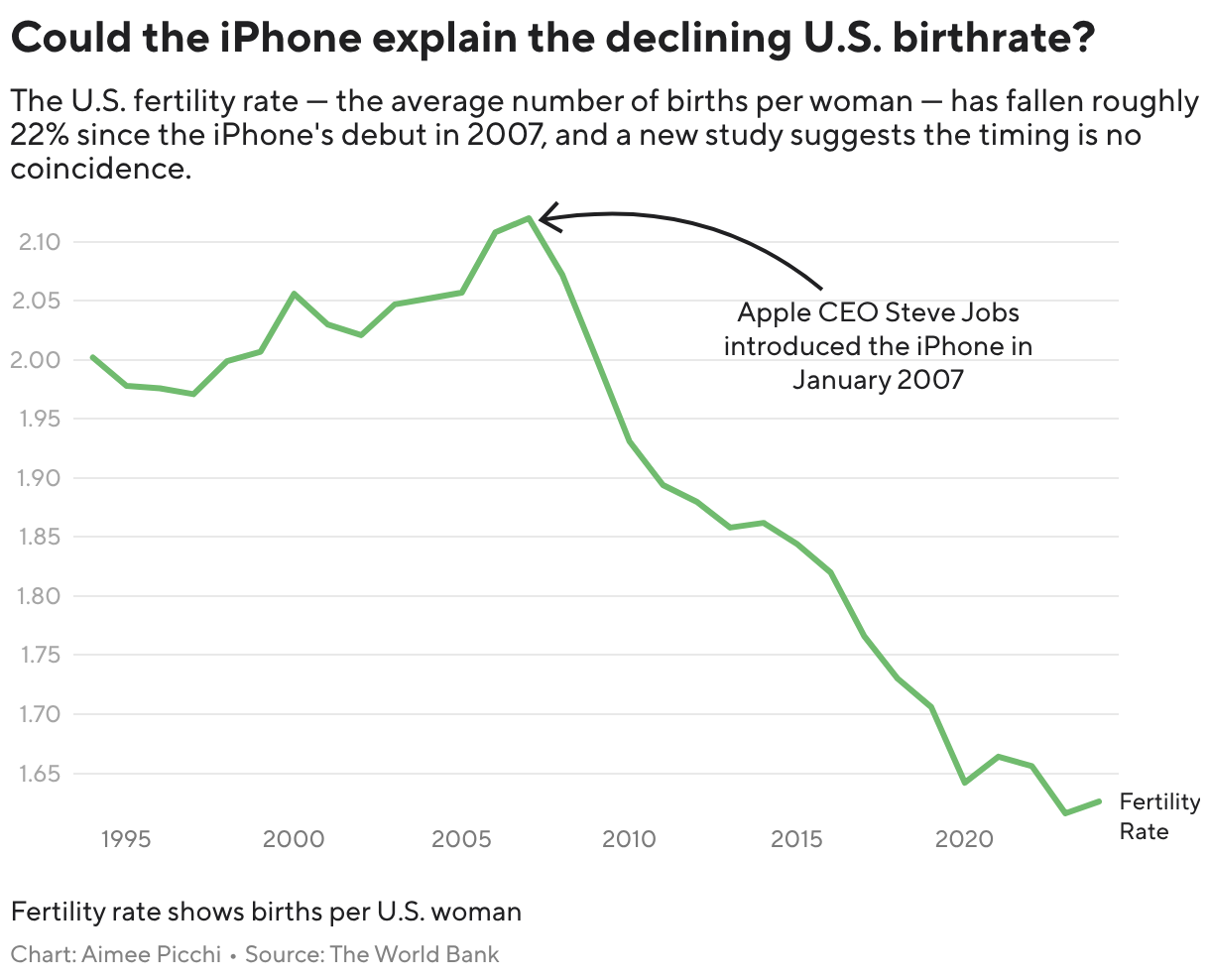
The findings rely on a natural experiment created by the iPhone’s exclusive distribution through AT&T from its rollout in 2007 through 2011. That allowed Myers to compare birth rates in U.S. counties with widespread AT&T coverage — and, therefore, access to iPhones — with those in regions with minimal access to the carrier’s service.
Myers told CBS News she wanted to check whether the results might reflect that AT&T’s coverage areas, which were focused in urban areas, were harder hit by the 2008 financial crisis. To do that, she ran several statistical checks, controlling for economic and demographic factors, and found that the iPhone effect remained consistent.
“I said, ‘Wow, but this has to be too big,'” she recalled. “I was like, ‘Let me try everything I can to explain away what I’m seeing in the data,’ and I just couldn’t.”
She added, “I’m not surprised that there is an effect. I am surprised that it stands out so, so clearly.”
Not the only factor
The declining U.S. birth rate could also be due to several other factors. Experts trying to explain the trend often cite financial issues, such as the high cost of child care, and the fact that more women are delaying having children or opting not to start a family.
Meanwhile, population growth has been slowing worldwide for decades in both rich and poor countries, not only in the U.S., according to economists.
Myers readily acknowledged that her research suggests that the iPhone only partially explains the drop.
“We’re not saying it’s all the iPhone. What we are saying is that it is a really important factor to consider,” she said. “Over this short period of time, it could explain about a third to a half of the decline. Now that leaves about half to two-thirds unexplained.”
The Trump administration has encouraged Americans to have more children and floated ideas such as a “baby bonus” for new parents. It has also introduced a new tax-deferred investment vehicle for U.S. children, offering federal government contributions of up to $1,000 to eligible kids.
Other countries have also introduced financial incentives to convince people to have more children, yet those efforts have largely failed to move the needle. Even countries that offer generous parental programs, like Norway, have seen their birth rates continue to decline over the past two decades.
A slow-moving crisis
Myers thinks the drop in birth rates is unlikely to be reversed solely through economic policy, such as tax incentives. And efforts to convince people to spend less time on their phones and more time making social connections “in real life” have mostly failed to gain traction, though more states are implementing cell phone restrictions for school-age children.
The possible link between how Americans use technology and birth rates has broader economic ramifications. On Tuesday, the Social Security Administration said the federal program is at risk of exhausting its trust fund as soon as 2023. Several factors — including the declining birth rate — are contributing to the approaching funding shortfall, according to the agency.
“It’s a real concern for economic growth to have a population with fertility below replacement levels,” Myers said. “We have a system set up where current workers support older retirees, and if we have fewer and fewer current workers, that becomes more and more difficult.”