Supreme Court turns away free speech case involving high school club’s “Defund Planned Parenthood” posters

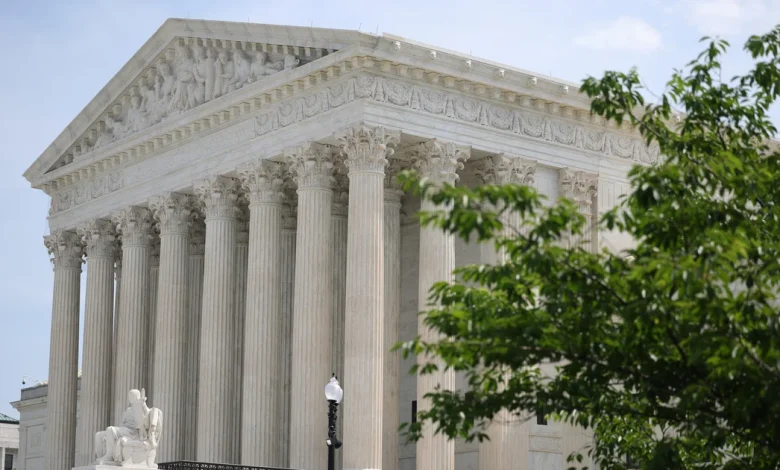
Washington — The Supreme Court on Monday turned away a free speech clash arising from an Indiana high school’s decision not to allow a student-led anti-abortion rights group to hang meeting flyers that featured the message “Defund Planned Parenthood.”
The dispute involved the scope of students’ free speech rights and schools’ ability to restrict expression that could be viewed as reflecting their endorsement. A lower court had sided with the school, and the Supreme Court’s denial of the case leaves that decision intact.
Justice Samuel Alito dissented from the Supreme Court’s decision and said the high court should “clarify the relationship between” a 1988 decision involving the regulation of school-sponsored activities and its other government-speech decisions.
The case dates back to 2021, when a freshman identified in court papers as E.D. launched Noblesville Students for Life, a chapter of Students for Life of America, at Noblesville High School. The club was among more than 70 “noncurriculum based” clubs at the school that are initiated and led by students.
The school allows the student clubs to hang flyers advertising meeting dates, times and locations on the walls in common areas, but they must receive approval from a school administrator to be posted. The high school does not allow the posters to include content deemed “political” or “disruptive,” according to court filings.
After E.D. received approval to form the club, she took steps to schedule an initial meeting and submitted to the school’s assistant principal two proposed flyers to inform students of the gathering. The template posters, which she obtained from the Students for Life of America website, featured photos of students holding signs that read “Defund Planned Parenthood” and “I am the Pro-Life Generation.”
The assistant principal denied approval of the posters and told E.D. that they should only include the club’s name and information about the meeting location, date and time. E.D., accompanied by her mother, Lisa Duell, then met with the school’s dean about the flyers, and they were told they could not include the phrase “Defund Planned Parenthood.”
The school’s principal then decided to suspend Noblesville Students for Life’s approval because of concerns that it was not student-led and student-driven, given the participation of E.D.’s mother, and because she refused to comply with instructions for meeting flyers. The club was reinstated in 2022 and remained active.
E.D.’s parents and Noblesville Students for Life filed a lawsuit against the school, arguing that their First Amendment rights were violated when the school refused to allow E.D.’s proposed posters.
But a federal district court ruled in favor of the school, finding that the flyers “could reasonably be perceived to bear the imprimatur of the school.” The district court applied a 1988 decision from the Supreme Court in the case Hazelwood School District v. Kuhlmeier, in which the high court held that a school can exercise “editorial control over the style and content of student speech in school-sponsored expressive activities so long as their actions are reasonably related to legitimate pedagogical concerns.”
“It would be reasonable for parents and other members of the public entering NHS for sporting events, student concerts, theater performances, parent-teacher conferences, or any other reason who observed such flyers displayed on school walls to erroneously attribute any political messaging they contained to the school district or the school itself,” U.S. District Judge Sarah Evans Barker wrote in a 2024 decision.
The U.S. Court of Appeals for the 7th Circuit upheld the district court’s decision, finding that students, parents or visitors to the school could view the posters as reflecting the school’s endorsement.
“This is not a case about tolerating private student speech,” the court found. “To the contrary, E.D. was permitted to wear her pro-life shirt to school and hand out her flyers to students at the activities fair. Instead, it is a case about whether the school must lend its resources (here, literally its walls) — and, by extension, its authority — to disseminate student messages.”
Additionally, the 7th Circuit said the school’s restriction on political content in flyers aimed to maintain “neutrality on matters of political controversy.” Allowing school walls to be covered with competing political messages would “divert attention from the business of learning,” the panel found.
E.D., represented by the Alliance Defending Freedom, a conservative judicial group, appealed to the Supreme Court. In a filing to the justices, they argued that the Supreme Court’s 1988 decision has been used by schools and universities to censor speech they deem controversial.
“That can’t be the right rule for our nurseries of democracy,” the plaintiffs wrote, adding that the federal appeals courts have adopted different views on the breadth of student-speech protections. In a landmark 1969 decision in the case Tinker v. Des Moines, the Supreme Court held that students do not “shed their constitutional rights to freedom of speech or expression at the schoolhouse gate.”
They warned that “public schools and educators increasingly engage in political advocacy and indoctrination, heightening the risk that students who dissent from the prevailing orthodoxy will be censored.”
But lawyers for Noblesville High School argued that the case is not about a student’s expression at school, and instead addresses whether a school “must lend its walls to students to disseminate political messages.”
Students are free to express their political views through other channels, they wrote in a filing, but said the school had the authority to restrict political content on materials posted on its walls.