U.S. Navy base employee in critical condition after shark attack in Florida – National

A U.S. navy base employee is in critical condition after being bitten by a shark on Monday in Panama City, Fla., according to authorities.

Officials said the worker from the Naval Support Activity Panama City (NSAPC) was swimming with a colleague near the marina during his lunch break at about 11:45 a.m. local time when the attack occurred.
Naval Support Activity Panama City Fire and Emergency Services responded to the incident and transported the man to a local hospital, where he was rushed into surgery, according to the NSAPC.
NSAPC Commanding Officer Tristan Oliveira told NBC News affiliate WJHG of Panama City that the victim sustained injuries on both of his arms, but the second person was not hurt.
Oliveira said the man is in his late 20s and has been with the navy base for four years.
“First and foremost, our prayers and thoughts go out to the family, and we want to send our appreciation to the first responders who rendered initial aid and made sure that the victim was properly and expeditiously taken to HCA Gulf Coast Hospital, and we continue to have the safety of all our personnel paramount in all the operations we do on base,” Oliveria told WJHG.
Global News has reached out to Bay County Florida Emergency Services and NSAPC for further comment, but has not received a response.
The Bay County Sheriff’s Office, the Florida Fish and Wildlife Conservation Commission and National Oceanic and Atmospheric Administration officials are investigating, WJHG reports.

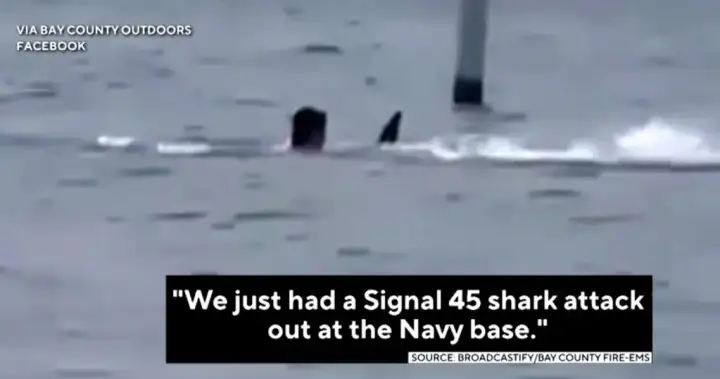
A short video of the incident was shared online and shows a man in the water yelling for help near the marina as a shark appeared beside him. A dorsal fin could be seen above the water.
An emergency call was also shared with a caller telling Bay County Fire-EMS that there was a shark attack at the navy base.

Get daily National news
Get daily Canada news delivered to your inbox so you’ll never miss the day’s top stories.
Authorities have not yet identified the type of shark involved in the attack, ABC News reports.
A new bill aimed at establishing an alert system, similar to the Amber Alert system, to warn beachgoers of shark attacks has become one step closer to becoming law.
The legislation, titled Lulu’s Law, was approved by the U.S. Senate and House of Representatives in May and is headed to U.S. President Donald Trump for approval.
Once the bill is signed into law by Trump, the Federal Communications Commission will be required to take action within 180 days, according to the legislation.
The bill comes after an Alabama teen, who narrowly survived a shark attack in June 2024, said she hopes the proposed alert system can help keep others safe in the water.
Lulu Gribbin was one of three people bitten by a shark on June 7, 2024, during a string of attacks off the Florida Panhandle. She lost her left hand and a portion of her leg.

The bill by Republican Rep. David Faulkner would issue a notice to the public when an unprovoked shark attack in the vicinity has occurred.
“Ninety minutes before me, there was another shark attack a couple miles down the coast,” Gribbin told The Associated Press last year.
Had she known about that attack, she and her friend would not have ventured into the water that day, she said.
“This bill will help prevent future attacks and accidents,” she added.
Gribbin and her friend had been diving for sand dollars before the attack. They were riding the waves back to the beach when her friend screamed, “Shark!”
“My hand was bitten first. I remember just lifting it out of the water, and I was stunned because there was no hand there. I couldn’t feel it because of all the shock I was in. Then the shark latched onto my leg,” she recalled.
While sharks are commonly found in the waters off Alabama and Florida, shark attacks are rare, Gavin Naylor, director of the Florida Museum of Natural History’s shark research program, told The Associated Press.
He said there are between 50 and 90 unprovoked bites around the world each year. And a trio of bites in a single day in close proximity is extremely rare, he said.
The University of Florida’s International Shark Attack File (ISAF) reports that the odds of being bitten by a shark are incredibly low. ISAF recommends ocean swimmers stay close to shore, avoid swimming at dawn or dusk and avoid excessive splashing.
—with files from The Associated Press
© 2026 Global News, a division of Corus Entertainment Inc.