Only 10 per cent of all plastics produced are recycled, so most plastics will end up littering streets, entering waterways and reaching the ocean. Each year, some 52 million tonnes of plastic waste enter the ocean, where it stays and affects more than 4,000 marine species.
A blue whale, the world’s largest mammal, can consume up to 10 million microplastic pieces daily, equivalent to about 43 kilograms.
To tackle plastic pollution, material innovation, increasing alternatives to single-use plastic and reducing production are essential, according to the latest World Ocean Assessment, which was released on Monday.
Manta rays in Bali, Indonesia navigate through plastic pollution.
For the past six years, the international community has been working toward a global plastics treaty that could cap plastic production and help “turn the tap off” on an industry valued at more than $1.1 trillion in 2023.
Negotiations are ongoing, with the next round of talks scheduled for 13 to 24 March 2027.
In the meantime, sustainable alternatives to plastics could help to reduce our global dependence, curbing the pernicious effects of plastic pollution on our oceans. However, alternatives must still overcome several major obstacles.
Tariffs hamper alternatives
One key challenge preventing sustainable alternatives from competing with conventional plastics is whether they can compete on cost in current markets.
Although the global trade in plastic substitutes reached $485 billion in 2023, growing the sector requires action to address tariff and non-tariff measures, limited market access and weak regulatory incentives.
“The key barrier is an uneven national and trade policy field,” the UN Trade and Development agency (UNCTAD) said.
Differences in tariffs are stark. Tariffs on plastic and rubber products have fallen over the past 30 years, from 34 per cent to 7.2 per cent.
Meanwhile, alternatives such as paper, bamboo, natural fibres and seaweed face average tariffs double the rate at 14.4 per cent, “making viable environmentally preferable alternatives less competitive,” UNCTAD said.
“Plastics have benefited from decades of market maturation, scale, infrastructure and favourable trade conditions,” UNCTAD said.
Amid this favourable climate for plastics, production continues to increase.
Global exports of plastics or goods made from plastic has more than doubled in value since 2005.
“The challenge is transforming a global packaging system that has been built around cheap, fossil-fuel-based plastics for decades,” said Ben Taylor, a representative of Notpla, a UK-based company that works with UNCTAD and makes biodegradable packaging out of seaweed and plants.
The biodegradable problem
Another challenge is that substitutes need very specific conditions to biodegrade – conditions that are often not found in the ocean.
“Many of the new biodegradable plastics only break down really in industrial composting conditions, with controlled temperature, moisture and microbial communities. And so, when you put them in the ocean, they don’t necessarily behave the same,” warned Ian Butler, a chief editor of the World Ocean Assessment.
Adding to this are concerns that some plant-based plastics substitutes can compete for land use for food production, which may result in larger downstream impacts.
“The belief that these biodegradable and plant-based plastics are the solution, it’s unfortunately giving the idea that we’ve solved the problem, everything is good, but that’s not the reality,” Mr. Butler added.
How alternatives can compete
Several key steps are needed for sustainable alternatives to challenge plastics on scale and “regain market share”, according to UNCTAD.
- Rebalancing tariff and non-tariff measures
- Reducing risks in sourcing non-plastic materials.
- Investing in newer materials, rewarding those that benefit the environment
- Building infrastructure to scale sustainably
While these changes will incur additional costs, UNCTAD believes that the long-term environmental benefit and socioeconomic value in terms of jobs, foreign-exchange, and regional development will counterbalance that.
Rise in energy costs accelerating transition?
In the meantime, one way this transition could be accelerated is if plastics suddenly became more expensive.
Currently, up to 98 per cent of plastics are derived from fossil fuels, with energy and petrochemical price volatility significantly affecting their cost and availability.
The price of polyethylene resin – the world’s most widely used plastic resin, commonly used in packaging – rose by an estimated 70-80 per cent in European markets between February and April 2026 following the closure of the strategically important Strait of Hormuz.
This has created momentum for substitutes based on renewables.
The ocean leads the way
The ocean itself might provide the solution, helping alleviate the pollution crisis which it is so deeply affected by.
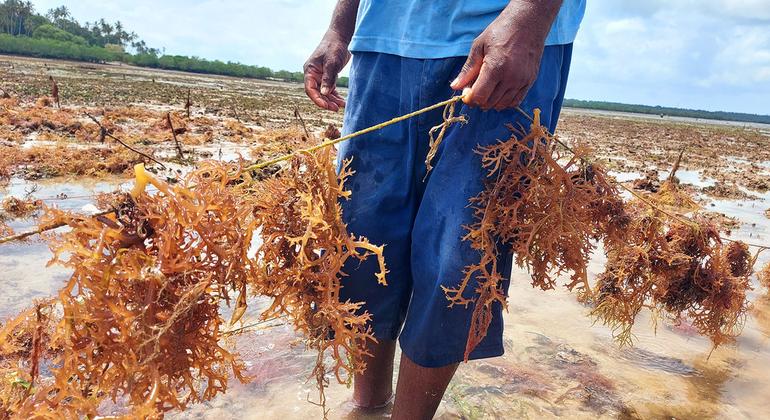
Seaweed-based materials, which are fully compostable, are emerging as a promising substitute for plastic – particularly in packaging. Seaweed is especially promising because it is a rapidly renewable resource that grows without freshwater, fertilisers or agricultural land.
Global seaweed production has tripled over the past two decades, while exports have quadrupled to reach $3.9 billion in 2022.
“As adoption grows, economies of scale improve and sustainable solutions become increasingly competitive,” Mr. Taylor said.
Regulatory gaps slow seaweed trade
However, the route is not straightforward for many producers, entering the global seaweed trade remains difficult as regulations around seaweed remain incomplete and fragmented – especially for new uses which are not clearly defined in international trading systems.
This creates confusion and makes it harder for exporters to comply with requirements – only 0.75 million of the 36.3 million tonnes of seaweed produced in 2022 were traded internationally.
Ultimately, this increases compliance costs for producers, especially for small businesses which seek to take advantage of the abundance of seaweed in many developing coastal countries, limiting their ability to export.
Local people from Watamu, Kenya, work with Local Ocean Conservation to pick up plastic on the beach each Friday.
Some optimism as momentum swings
Without stronger incentives, clearer regulations and improved market access, sustainable alternatives will struggle to compete with conventional plastics.
A change in momentum and public pressure can help accelerate the transition.
“What gives us optimism is the momentum we are seeing around the world. Consumers are demanding better solutions, businesses are setting ambitious sustainability goals, and policymakers are introducing regulations designed to reduce unnecessary plastic waste,” Mr. Taylor said.