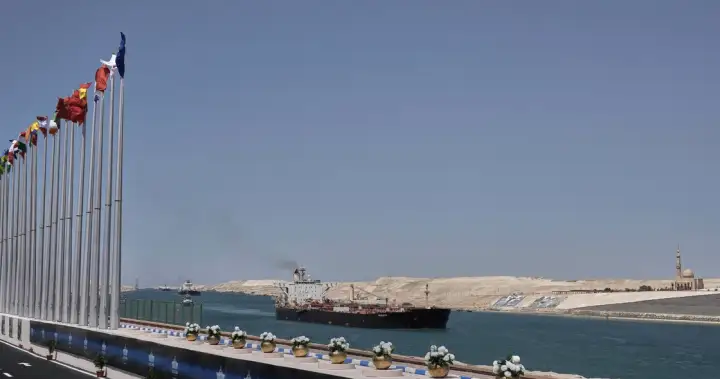
A drone strike on gas vessels in Egypt’s Mediterranean port of Damietta signaled a potential new front in the U.S.-Iran war, raising the prospect of threats to navigation through the Suez Canal, a last remaining safe export route for Saudi oil.

The Egyptian cabinet said on Thursday that an initial investigation showed that an unidentified drone caused a fire on Wednesday on two vessels at Damietta port, near the Suez Canal, which links the Mediterranean with the Red Sea.
No group has claimed responsibility, the cabinet said, adding that authorities were taking measures to protect Egypt’s national security.
Trading sources familiar with the incident said the drone hit U.S.-owned gas storage tanker Energos Winter, causing a fire that spread to another vessel.
Overnight, the U.S. military said it struck Iran’s Revolutionary Guards’ military command centers and drone facilities after Tehran fired at U.S. forces in the region.
Iranian state media, quoting the Guards, said three civilians were killed and two children wounded in U.S. strikes on Qeshm Island, while three Guards members were killed in Zanjan province.
The governor of Khuzestan province, cited by Iranian state media, said two student dormitory complexes in the southwestern city of Ahvaz were damaged in the overnight attacks.
The Islamic Revolutionary Guard Corps said it struck the U.S.-run Azraq base in Jordan in response to the U.S. strikes.
“With the help of God, the aggressor will be punished today,” it said earlier in a statement carried by state media.
The Pentagon did not immediately respond to a request for comment about damage at the Azraq base.
U.S. bases in Jordan have lately become primary Iranian targets. Jordan’s armed forces said earlier on Thursday they had intercepted five Iranian missiles.
An Iranian attack also hit a building owned by a Chinese company in northern Kuwait, killing a worker and inflicting significant damage, Kuwait’s Defence Ministry said.

In a first in the five-month war, Saudi Arabia on Wednesday publicly joined strikes alongside U.S. forces, targeting Iran-aligned groups in eastern Iraq, in retaliation for drone attacks on Saudi oil targets launched from Iraq.
After the joint attacks, Saudi Arabia’s defense minister met U.S. Vice President JD Vance in Washington on Wednesday to urge the Trump administration not to escalate the conflict further, two sources told Reuters.

Get breaking National news
Get breaking Canada news delivered to your inbox as it happens so you won’t miss a trending story.
The war began in February, when the U.S. and Israel launched a bombing campaign in Iran that U.S. President Donald Trump said would last only a few weeks. A temporary ceasefire agreement in June collapsed amid renewed fighting over the Strait of Hormuz, a crucial waterway that Iran says it now controls.
The latest strikes in Iraq and Egypt threatened to draw more Middle Eastern countries into the conflict after the Iran-aligned Houthis in Yemen declared a naval blockade last week on Saudi Arabia, threatening the alternative Red Sea route for its oil to Asia.
Attacks on ships by the Houthi militants prompted London’s marine insurance market to widen its “high risk” zone in the Red Sea to include more of the coast adjacent to Saudi Arabian ports.
Trump said he would hit Iran hard for firing missiles at U.S. forces, but that Washington was also still seeking a peace deal to end a conflict that has roiled global energy and finance markets.
Oil prices soared more than 8 per cent on Wednesday, before easing 1 per cent on Thursday in volatile trade, with benchmark Brent crude trading just below the US$90 mark.

Iran controls crucial shipping waterway
Iran said on Wednesday that it struck three tankers attempting to transit through the Strait of Hormuz along an unauthorized route.
However, a QatarEnergy-controlled liquefied natural gas tanker exited the strait overnight, the first such vessel recorded by ship-tracking data leaving the waterway since July 11. Iran’s semi-official news agency Fars said Tehran had given its permission for the tanker to pass.
Oman has presented Iran with a plan backed by Gulf states to manage the Strait of Hormuz, including collecting voluntary fees for using it, sources told Reuters on Tuesday.
Tehran rejected the Omani proposal on Wednesday, but Iran’s semi-official ILNA news agency quoted the country’s foreign ministry spokesperson Esmaeil Baghaei as saying that talks with Oman over the Strait of Hormuz were continuing.
After the war exposed gaps in Iran’s ability to protect military sites and strategic infrastructure, Tehran was expected to receive within weeks a first shipment out of up to 400 Chinese-made shoulder-fired air-defense missile launchers, three sources familiar with the deal told Reuters. Iran’s Foreign Ministry did not immediately reply to a request for comment, while China’s Foreign Ministry denied the report.