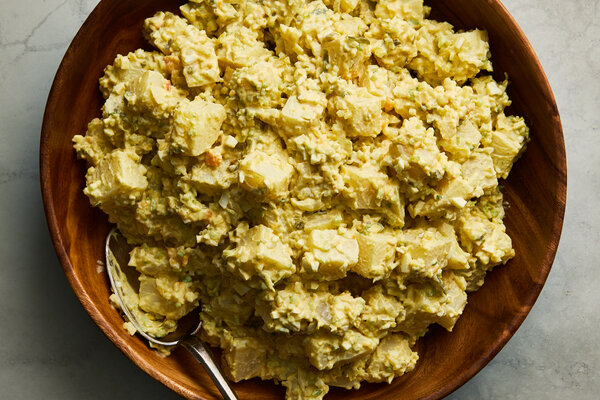
Not long ago, I found myself drowning in recipes for potato salad. I wish I knew why this happened. An idea had possessed me, and I was trying, if not to exorcise it, then at least to apply the pressure of research.
So I turned to Bonnie Slotnick, who runs a shop in the East Village of Manhattan that specializes in rare and antique cookbooks, and started riffling through every book she could find me with a recipe for potato salad.
What we found took us from the late 19th century to the four potato salad recipes in “The Settlement Cook Book,” from 1943, and the joyous wanderlust of Clementine Paddleford’s 1960 compendium “How America Eats.” I pored over Mimi Sheraton’s 1965 “The German Cookbook,” with its instructions for one hot and one cold potato salad. I beheld the tossed-off nerve that suffuses “Princess Pamela’s Soul Food Cookbook,” from 1969, and marveled at the more elegantly earthen approach of “Spoonbread and Strawberry Wine,” a 1978 book by the sisters Norma Jean Darden and Carole Darden-Lloyd. Classics all.
Really, I was looking for confirmation. Could what I sensed be true? Because what I sensed sounded a touch absurd, and it was this: Potato salad is the Great American Dream Dish.
In any year, potato salad is what you put out or bring to gatherings between Memorial Day and Labor Day. But now, as this country turns 250 years old, I think a hearty vat of mayonnaised (or oiled) Yukon golds carries an even heftier significance, as the most characteristically American food we have, that we’ve ever had.

Credit…Cannonball with Wesley Morris
I can already hear you: What about the hot dog? A hot dog does say “America.” I just read a love letter to Costco’s hot dog that gave me momentary pause about the singular glory of potato salad. But when’s the last time you made a hot dog from scratch and brought it to a cookout?
I believe that potato salad is the greatest thing you can bestow upon an American spread. Not because it’s the most delicious or the prettiest, although never rule either out. I believe this, in part, because anybody can make some and bring it. It’s simply potatoes and a bunch of other stuff.
When someone new to this country arrives, they learn — somehow! — that this is the dish you bring to a gathering. It’s the dish that indicates a desire to understand this place, and they appear to have heard that this bowl of lubricated tubers is the way to go. Depending on whom you heard that from and whence you hail, you might feel free to add some cured pork, a scoop of gochujang or a jar of capers.
That’s your contribution to the complexity of this dish, your contribution of your culture to ours, of yourself to the promise of this place. This is an offering that can say both “welcome” and “we are.”
Every culture in America already seems to have some expression of potato salad. Jewish deli. Japanese. German. Calabrian. Nepali. Bodega. A dear friend of mine is Peruvian and knows from a potato. She told me that in Peru it’s ensalada rusa, and in Spain, ensaladilla rusa: potatoes, carrots, peas and sometimes cubed beets with mayonnaise. Somebody has brought a beety rusa to this Texas barbecue!
Potato salad isn’t a meal. It’s an accompaniment, support for whatever else surrounds it. It unites a plate and soothes the palate. It complements the fried and cools the hot. It’s reliable. It’s expected.
It can also go a little wild. Take a chance. Innovate. No matter what, we the eaters hold the truths of your dish to be self-evident.
It’s true, too, that potato salad can polarize. The choice of mayonnaise alone could start a war. Please, whip your miracle somewhere else. If no one brings a potato salad, an existential breach has occurred: How could nobody care enough to bring one?
But also: Who has what it takes to dare, to meet the moment? Potato salad is the Thanksgiving turkey of summer summits. No one will forget that time you messed it up. (Conversely, we’ll all rejoice anytime you put your foot in it.) I love potato salad for this. If getting our founding documents in order was a trial, imagine a constitutional convention to define potato salad. It’s the most divisive dish we have that we also agree we’d feel incomplete without. A true soul food.
***
Who knows when I became a potato salad person? Probably the minute somebody in my family — my mother, born Judith Lavern Smith — figured out that I could handle a knife and survive an onion. I’m going to say I was 11.
My mother’s potato salad was onion-y enough that it bit you back. For a sous-chef, this meant getting a softball as close to slurry as your sinuses would permit. I’d quarter the onion, chop it up, present it for inspection, fail, then resume and chop until I passed. This could take half an hour. My mother needed less than five minutes. But if she was making potato salad, it often meant she was making something else, too, and something else and then one more thing. So even a slow helper was a help.

Credit…Armando Rafael for The New York Times. Food Stylist: Simon Andrews.
By the time I was 14, I had graduated to taking on more tasks: mincing the celery, pulverizing sometimes a dozen eggs, peeling potatoes and carving them into dice, drizzling the mustard, strangling the relish to drain every drop of its syrup, scooping out the Hellmann’s then slapping it onto everything else.
When it was time for paprika, salt, pepper and the all-but-accidental pinch of sugar my mother used, she took over. It’s perfectly fine to trust a child with a paring knife. Bad parenting is entrusting one with seasoning.
Everybody adored my mother’s potato salad. They could taste the love (and, if I may say, the labor). It was essentially the recipe her grandmother used, and now the potato salad I make. Every bite contains every ingredient. So what you’re savoring is cream and crunch, sweetness and — because I’m a seasoned seasoner now — the paprika’s heat. This is a vivid, lively dish, sparked by a convergence of texture and flavor and color. Not once had I considered that harmony as being anything more than what my mother learned from her grandmother, a family thing.
It wasn’t until I started poking around Bonnie Slotnick Cookbooks and sitting with the recipes Bonnie indefatigably kept serving me that I could see a story taking shape. In book after book by Black authors, or books that could claim a Black author (because, say, a white woman published what she swore were her cook’s recipes), it became evident that my people’s potato salad was more or less My People’s: the mustard and variations on mayonnaise, the egg and onion, sometimes celery and a cucumber.
There had never been a recorded recipe in my family. Like music and storytelling, food was lore, a byproduct of a slavery, an institution that denied literacy to enslaved people for fear of what a literate slave could achieve. We made do. We made potato salad. What I found at Bonnie’s was a history. What I found was an inheritance.
But! Something else to appreciate about this dish is that unlike, say, macaroni and cheese, potato salad is not a product of enslavement. Black Americans have a claim on it, but it belongs to no one.
The covenant this country has made to individual liberty and pursued happiness, to justice and equal protection, can feel false, impossible, elusive. Not when it comes to potato salad. Potato salad is the covenant and the country — this wet mess of harmonic convergence, achieved only through imagination and patience and a kind of violence (So. Much. Chopping), but also some fealty to our core, earthen values.
This dish is a present Americans have been giving one another for much of the past 250 years. It’s a dish that keeps insisting that we belong.
Follow New York Times Cooking on Instagram, Facebook, YouTube, TikTok and Pinterest. Get regular updates from New York Times Cooking, with recipe suggestions, cooking tips and shopping advice.