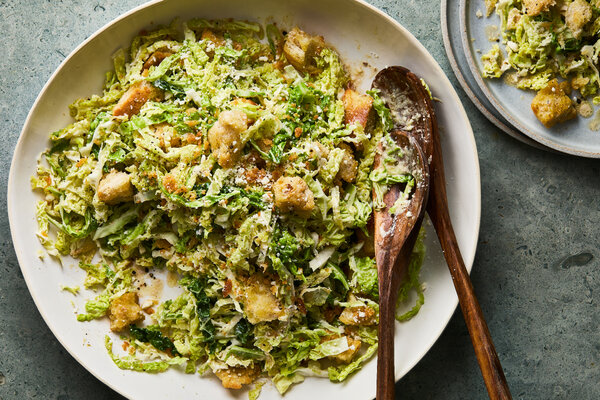
The allure of a Caesar salad lies in its dressing — the sting of raw garlic, the salty umami of Parmesan, that anchovy funk. What you toss it with is less important. As long as it’s sturdy enough to bring that dressing to your mouth, any green will work just fine.
Mild and crisp romaine has been the classic since the 1920s, when the salad was first put on the menu at Caesar’s restaurant in Tijuana, Mexico. Kale Caesars and brussels sprouts Caesars had their moments, those ruffled leaves adding an earthy, mineral tang. But I think cabbage works best of all.
Of all the greens, cabbage is the sweetest and crunchiest, with a pronounced contrast to the dressing that’s both satisfyingly textural and a little unexpected. Cabbage makes the whole salad livelier to eat.
It also keeps well. Unlike romaine, which starts to wilt the moment it meets the dressing, cabbage stands its ground. I made this salad one evening for dinner, then stuck the leftovers in the fridge. The next day, it was just as good — the flavors more integrated, the cabbage, though softer, still gratifying in a coleslaw kind of way.
If you do make this salad ahead, though, don’t add the croutons until serving. You want those to stay as crunchy as possible.

Don’t add the croutons until serving to ensure they stay crunchy.Credit…Armando Rafael for The New York Times. Food Stylist: Simon Andrews.
To further increase the crunch, I tear the bread rather than cut it. Torn bread has ragged, uneven edges that get extra crisp as they toast. Tossing the pieces with olive oil and a few tablespoons of grated Parmesan also helps the cause. As the croutons bake, the cheese melts into brittle, lacy patches along the edges. Use a spatula to scrape them up and fold them into the salad. Those fricolike bits are arguably the best part.
As for the anchovies, to me they are nonnegotiable in a Caesar salad. But sticklers will tell you that they’re not actually traditional. The original recipe gained its saline bite from Worcestershire sauce (which contains anchovies). It’s unclear when the salted fish made their way into the bowl, but now their presence has been firmly established. That said, if you want to skip them, use capers instead. Or olives, or even feta, all of which will add the necessary brininess.
You see, at its heart, Caesar salad is very adaptable. That’s one reason it’s been around for the past century — and it bodes well for the next.
Follow New York Times Cooking on Instagram, Facebook, YouTube, TikTok and Pinterest. Get regular updates from New York Times Cooking, with recipe suggestions, cooking tips and shopping advice.