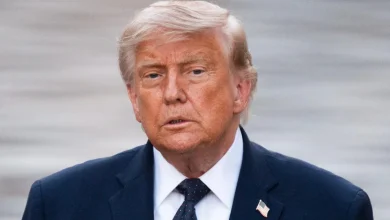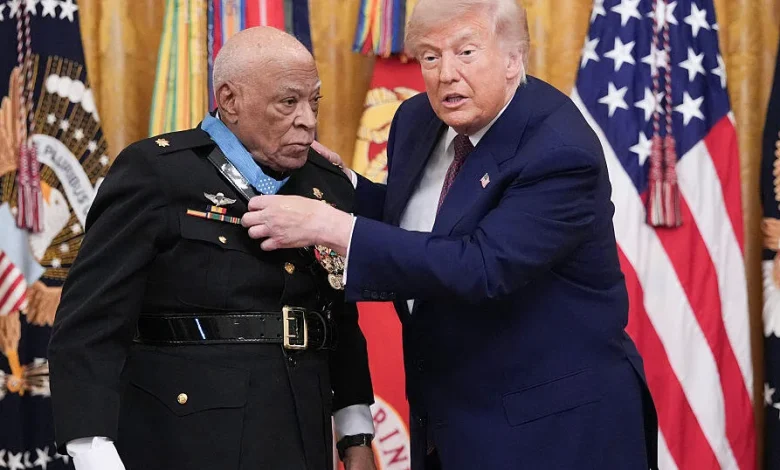
President Trump on Thursday conferred two Vietnam War veterans and one veteran of the Afghanistan War with the Medal of Honor, the nation’s highest military award.
In a ceremony at the White House, the president paid tribute to retired Marine Corps Maj. James Capers Jr., retired Army Maj. Nicholas Dockery and Marine Col. John W. Ripley, who died in 2008.
Among those who attended the ceremony were Defense Secretary Pete Hegseth, U.S. Ambassador to the United Nations Mike Waltz, and Sen. Lindsey Graham of South Carolina.
Retired Marine Corps Maj. James Capers
Ken Cedeno /AFP via Getty Images 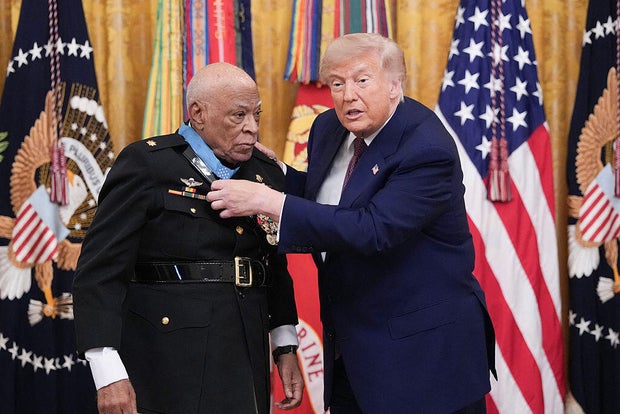
Capers, now 88, was part of a four-day reconnaissance patrol in Vietnam in March and April of 1967, according to the White House. On the final day of the patrol, his battalion was ambushed by a claymore mine and came under heavy enemy fire, during which he suffered multiple gunshot wounds.
“Shrapnel peppered his body in 17 places,” Mr. Trump said during the ceremony. “… Every one of his fellow Marines went down wounded, but Jim rose, pushing forward on a leg that shouldn’t have been able to carry any of his weight. After a shot of morphine, Jim asserted command of the firefight.”
Capers successfully led his team to an extraction site, where he refused to evacuate before all his men were safely aboard the rescue helicopter.
“When the helicopter groaned under the weight of the entire team, too many people, he attempted to deplane, but his team physically held him back, refusing to leave their leader behind,” Mr. Trump said.
Marine Col. John W. Ripley
Andrew Harnik / Getty Images 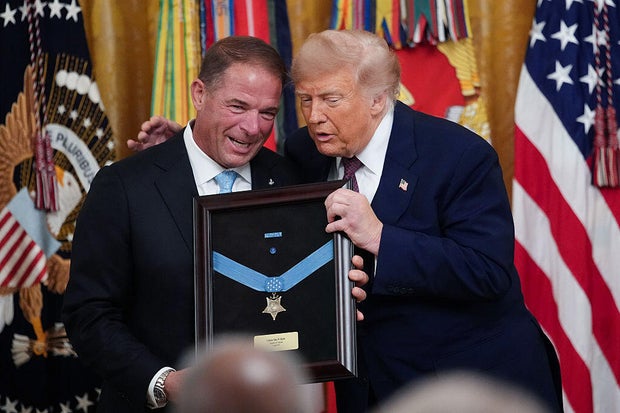
In April 1972, Ripley halted a North Vietnamese assault while serving as an adviser to the South Vietnamese army, the White House said.
As part of what became known as the Easter Offensive — then the largest ground invasion since the start of the Vietnam War — the North Vietnamese army had pushed south in an attempt to capture a bridge in Dong Ha.
“As North Vietnamese forces surged through the north river bank, it became clear that the assault could only be stopped by destroying the bridge,” Mr. Trump said.
Ripley, the only soldier with sufficient demolition experience, single-handedly moved 500 pounds of explosives beneath the bridge over the course of several hours.
“Hand over hand, he climbed, dangling beneath the bridge, and over the rushing water…Completely exposed to withering enemy gunfire, John completed, not one, not two, but five such trips,” Mr. Trump said.
Ripley then successfully detonated the charges, destroying the bridge and preventing the North Vietnamese army from advancing.
“When John detonated the explosives, the bridge collapsed into the river, crushing the advance, and saved the hope of a free Vietnam for Easter morning,” Mr. Trump said.
Ripley was previously awarded the Navy Cross for his actions that day. His three sons and several other family members attended Thursday’s ceremony.
Retired Army Maj. Nicholas Dockery
Al Drago / Getty Images 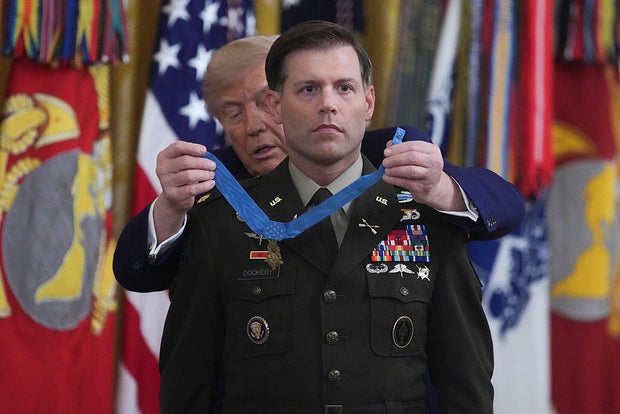
Dockery was serving as a platoon leader in the Kapisa Province of Afghanistan in October 2012 when his platoon was ambushed by dozens of Taliban fighters, the White House said.
“The enemy unleashed overwhelming torrents of fire from machine guns and rocket-propelled grenades,” Mr. Trump said during the ceremony. “Without concern for his own life at all, Nick raced across the open ground to rally his scattered team.”
Over the next four hours, Dockery fought the Taliban forces in urban terrain, risking his life several times. No one on his team was lost that day, the White House said.
When he realized that one of his team members was missing, “Nick rushed through the compound until he found the sergeant being dragged through an alleyway by two Taliban fighters,” the president said.
Dockery killed the two Taliban fighters and rushed the sergeant to safety. When he discovered the sergeant was not breathing, Dockery began CPR, resuscitating the sergeant, Mr. Trump said.
He successfully evacuated three wounded members of his platoon after he climbed onto an open roof, making himself vulnerable to more enemy fire, and signaling U.S. military aircraft to “come to the platoon’s rescue.”
“He signaled enemy positions with smoke grenades, allowing American gunships to come to the platoon’s rescue,” Mr. Trump said, noting that Dockery was the “last man to depart the battlefield that day.”