Hegseth slams NATO and ‘middle powers’ talk, launches Europe troop review – National

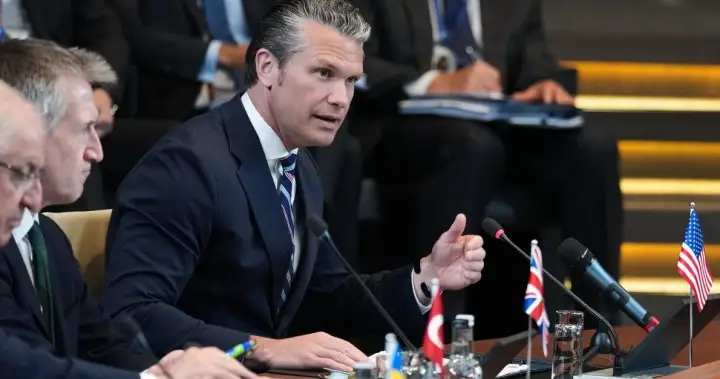
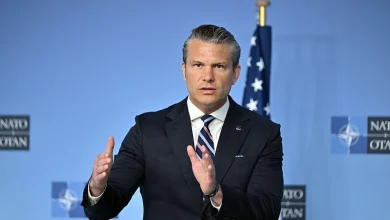
U.S. Defense Secretary Pete Hegseth on Thursday lashed out at NATO allies during the announcement of a six-month Pentagon review of U.S. forces in Europe, saying the future of the alliance depended on others stepping up their defence spending.

He also appeared to take a veiled dig at recent remarks made by Prime Minister Mark Carney about middle powers needing to band together.
Hegseth, addressing defence ministers at NATO headquarters in Brussels, said the goal of the review was to prompt Europe to do more while ensuring the U.S. military would be able to meet its global commitments. He added that NATO needed to return to “a hard-edged warfighting organization focused on Europe’s defence,” after decades of “free riding” by non-U.S. allies.
Although Hegseth didn’t mention Canada or any other country by name, his remarks appeared to allude to Carney’s speech at the World Economic Forum in January while criticizing allies that “have yet to show a credible path” to meeting their NATO spending commitments.
“Some of NATO’s largest economies, some of the richest countries, allies that are happiest to go on about the rules-based international order and middle powers banding together, still seem to think the era of free riding is here,” Hegseth said.
“This isn’t what the president or America expects from this alliance. This is not what any reasonable person would expect, and it’s not going to cut it anymore.”
Carney said during his speech: “Our view is the middle powers must act together because if we’re not at the table, we’re on the menu.”
The Trump administration has voiced frustration with Canada in recent months for not clearly showing how it plans to reach NATO’s new target of spending at least five per cent of GDP on defence by 2035, including 3.5 per cent on “core” military capabilities.
Soon after the U.S. paused a joint defence review board with Canada last month, a senior Pentagon official said Canada hasn’t made “the hard decisions and tradeoffs needed” to be a “credible” military partner.
The official added Canada “has yet to articulate a path to reach NATO’s new defense spending targets,” and that talks meant to produce a clear action plan for increasing military readiness have broken down.
Defence Minister David McGuinty has pushed back on that criticism, pointing to past spending announcements that finally brought Canada to NATO’s old target of two per cent this year, as well as future procurement plans that he said will get Canada to five per cent on schedule.
Global News has asked McGuinty’s office for comment on Hegseth’s remarks. The minister attended the NATO ministers’ meeting and was due to travel to Luxembourg on Friday.

Review could lead to U.S. troop, spending cuts
Hegseth on Thursday also echoed criticisms by U.S. President Donald Trump and other administration officials that some NATO allies wouldn’t allow U.S. forces to use their airbases in the opening days of the war with Iran, and were otherwise slow to offer assistance.
The defence minister called those decisions “shameful” and said they “put America’s sons and daughters, our sons and daughters, at risk.”

Get daily National news
Get daily Canada news delivered to your inbox so you’ll never miss the day’s top stories.
He told his NATO counterparts that the six-month review will improve U.S. force posture and basing in Europe, while incentivizing allies to “step up and do their part.”
“Make no mistake about it, this will be a real review,” he said. “It will be designed to ensure that NATO is moving fast and irreversibly toward Europe leading, stepping up to take primary responsibility for the defence of Europe.
“It’s a review that some countries will fail, and others will pass with flying colours.”
Hegseth added that U.S. “dues” to NATO — likely referring to allies’ shares of common funding to NATO capabilities — will be “contingent on other countries meeting their defence spending targets.”
“Where other allies do not spend with urgency, our dues contributions will go down,” he said. “NATO will be a two-way street.”
NATO Secretary-General Mark Rutte noted on Thursday that European allies and Canada together spent US$90 billion more on defence last year, a 20 per cent increase over 2024.

Hegseth’s announcement came after the U.S. told its allies last month that it had decided to shrink the pool of U.S. military capabilities available to the alliance in a crisis, a framework known as the NATO Force Model.
Rutte downplayed the impact of the move, calling the force model “a planning tool,” but acknowledged that the reduction of U.S. contributions has already taken effect.
“The question yesterday came up: Is this immediate or not? It is immediate,” he told reporters.
“So what would happen in reality? If war would break out … all allies, including the U.S., will max out what they can do to make sure we can fight the war.”
He said some European countries “are already backfilling a lot of those resources, in other cases, we are nearly there, and there is still areas where we need more work to do. So we are in a good place.”
The U.S. announcement has nevertheless sent allies scrambling to fill the gaps in their own crisis forces.
U.S. air force Gen. Alexus Grynkewich, NATO’s top commander and the head of U.S. forces in Europe, said in a statement earlier this month that manned and unmanned aircraft and naval vessels are two areas where Canada and European allies “can step up now and in the near term — as the United States reduces forces ‘sourced’ to the NATO Force Model in Europe and refocuses them elsewhere.”
Under NATO’s collective security guarantee – Article 5 of its founding treaty – the 32 allies pledge that an attack on one of them will be considered an attack on all. It does not oblige them to provide military support, although many likely would.
In essence, the United States is scaling back how it might help, should an ally trigger Article 5.
Article 5 has only been invoked once, after the Sept. 11, 2001 terrorist attacks on the U.S., which led to NATO forces fighting alongside America in the wars in Afghanistan and Iraq.
— with files from Reuters and The Associated Press
© 2026 Global News, a division of Corus Entertainment Inc.